Real Life Matters

A blog about what is real in life, and what matters

“Oh, the history books tell it, they tell it so well

The cavalries charged, the Indians fell

The cavalries charged, the Indians died

Oh, the country was young, with God on its side”

– Bob Dylan

It has taken a while to finish this post. Starting it was easy. I gravitated immediately to Bob Dylan song, but then I hit a wall. I set out to write something meaningful about the poignant history of the Anishnabe (First People) in Michigan. As it turns out, writing about history is not easy. History leads you down one curious rabbit hole after another. Plus, it is inherently challenging for a 21st-century mind to understand anything about anyone who lived in the 17th, 18th or 19th centuries. It is hard enough to imagine life before the Internet, much less life before electricity, plumbing or running water. But there are lessons here worth learning. How we treated one another in the past gives us unique insight into how we should treat people today who we encounter who are different than us.

The story about the First People in upper Michigan is nuanced. A lot happened after the Europeans arrived in 1659. Territory changed hands in a blur of dates until 1815, when England and America entered into the Treaty of Ghent, ending the War of 1812. Even more happened between the War of 1812 and January 6, 2021, which marked the first time since August 24, 1814, that a hostile force took over the U.S. Capitol. This time, insurgents punched their ways through glass and doors, defecating and urinating on federal property, and marching a Confederate flag through the U.S. Capitol building.

I sometimes wonder what life in North America would be like had Europeans and the Americans not shown up in force and taken over the place. The First People got overshadowed by overwhelming economic and political forces. It is like the scene in Dances with Wolves, where Kicking Bird asks John Dunbar about the number of white people that will eventually come to the Prairie: “How many?” Dunbar motions to the heavens and says, “Like the stars. . . .” [1]https://en.wikipedia.org/wiki/Dances_with_Wolves

With its woodland upper and lower peninsulas, Michigan would scarcely be recognizable today if Europeans had not migrated here. Imagine arriving in Detroit from an overnight flight from Europe, walking through customs, and showing your passport to an Alongquin Nation customs and border protection officer for admission for 90 days as a visitor for business or pleasure. Contrary to popular myth, the First People did not vanish. They are still here. In most cases, however, they do not hold the keys to power in America, which makes it challenging to see them and hear what they have to say to us – and they have a lot to say.

They call themselves and all Indians the Anishnabe (First People). At first they were the “Otchipwe” as written by Bishop Frederick Baraga. The French pronounced it “Ojibway” and the English called it “Chippewa.” The two names are used today and sometimes the Central Ojibwe are called the Chippewa, but they are all the same people. They make up the nucleus of the Algonquin Nation. This huge nation was made up of many tribes and, though some have drifted far from the main groups, they can still be recognized by their language origin. Besides the Ottawa, Chippewa, and Potawatomi there are the Fox, the Sac, the Saulk, Menominee, Pocumtue, Narragoset, Munsee, Massachusett, Massauaketon, Pennocook, Penobscot, Mohican, Delaware, Shawnee, Miami (or Omaumeg), Kickapoo, Sutia, Cheyenne and Arapaho, Salteaux, Ok-ewein, and, yes, the Sanguinay (whom the whites called the Beaver), as well as many others.

The Algonquin tribes occupied the region around the Great Lakes and practically all of the drainage area into these waters. North of them were the Cree (also of Algonquin origin), west of them were the Sioux, south of them were a group of tribes collectively called the Illinois, and east of them were the Iroquois, made up of such tribes as the Seneca, Cayuga, Oneida, Mohawk, Onandagas, and, after 1712, Tuscaroras – a league known as the Six Nations. For hundreds of years, the greatest enemies of the Algonquin People were the Iroquois and the Sioux. The warring, if any, was all east and west, seldom if ever north and south. [2]Rydholm, C. Fred (1989). Superior Heartland, a Backwoods History (Vol. I), pp. 28-29.

The French fur trappers and Jesuit priests were the first Europeans to arrive in what is now known as the upper peninsula of Michigan in the mid-1600s. The trappers were on the hunt for otter, marten, mink, and especially beaver pelts for trade back to Europe, which could not get enough of them to make hats. The Jesuits, on the other hand, were in search of souls to be converted to Christianity.

The First People were a peaceful, woodland people. When required, however, they defended their territory when the Sioux attacked from the west, and when the Iroquois attacked from the east. History also forced the First People to cope with ever-increasing numbers of Europeans and Americans filling the shores of the Great Lakes. The Europeans brought with them concepts about land ownership that were foreign to them. Europeans also brought new technology, especially guns. A long gun could keep an entire village in the upper peninsula from starving by ensuring a reliable supply of venison all winter long.

The French and the British also brought to North America their relentless obsession for dominion over one another. The First People got caught up in these struggles. They formed fleeting alliances as the situation unfolded from their own perspective. From 1754 until 1763, the First People and the French fought against the British and their allies, the Iroquois people, in the so-called French and Indian War. In 1763, at the conclusion of this war, England was victorious the British expelled the French from most of North America. King George III proclaimed that all of the lands west of the Appalachian Mountains and east of the Mississippi River belonged to Native Americans.

Thus, at least for a few years, it looked like the First People would finally be able to hold onto a relatively large portion of their traditional territory, including all of what we now know as the territory of the State of Michigan, all the way south to the Gulf of Mexico.
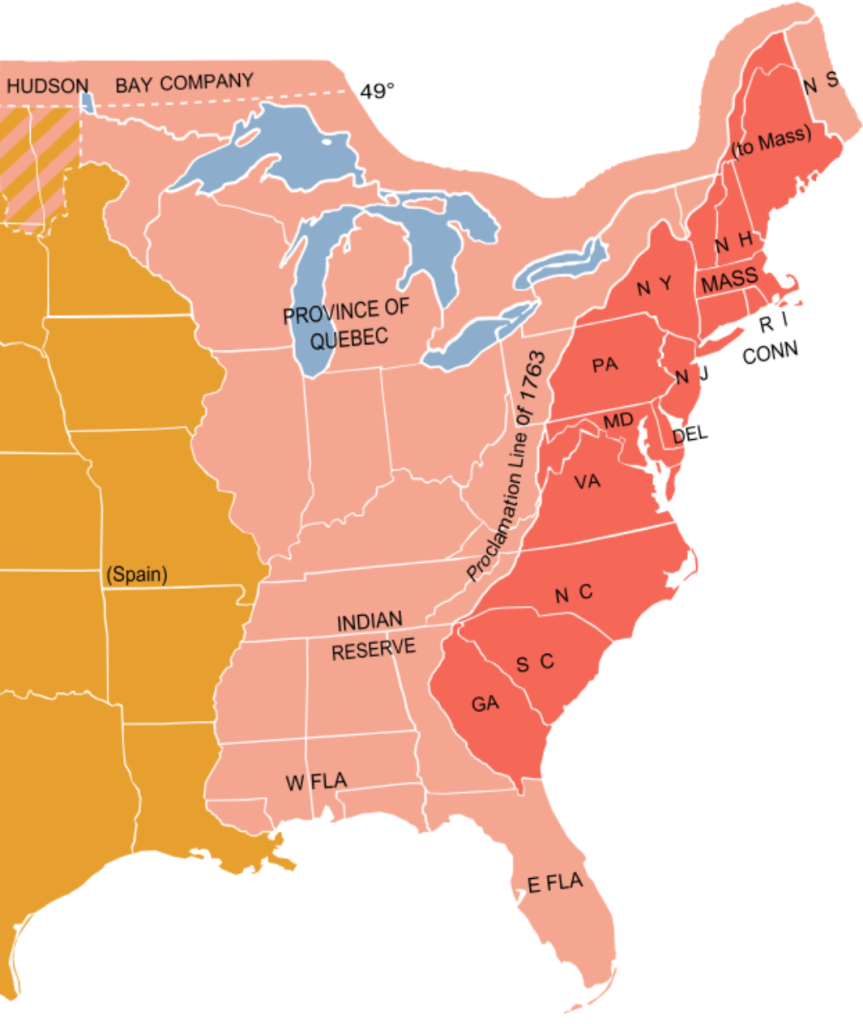
North America in 1775 after the French and Indian War

But it would not last. King George had to impose taxes on the colonies to repay the massive debt the Crown incurred to cover the cost of its wars in Europe and North America. Local Americans resented this taxation, along with other encroachments, like the quartering of troops in private homes. You already know what came next:  the American Revolutionary War. At its conclusion, America won possession of all of the former British colonies along the eastern seaboard along with the Great Lakes. Everything was set forth meticulously in the Treaty of Paris (1783).

This was a difficult blow to the First People. Gone now was the huge territory in the Ohio Valley reserved for the Anishnabe and various other tribes of Native Americans. The French had left. The British had mostly left. Now the Anishnabe were forced to deal with the Americans.

Having a treaty signed and ratified is one thing. Enforcing it is an entirely different matter. The British refused to evacuate their forts in the Great Lakes for years after the Revolutionary War, arguing, probably correctly, that the Americans had not fulfilled all of their obligations under the Treaty of Paris.

President George Washington eventually dispatched Supreme Court Chief Justice John Jay to England to negotiate with the British an end to these lingering disputes. England and the United States entered into the Jay Treaty in 1794. In this treaty, the British agreed to vacate Fort Miami, Fort Detroit and Fort Mackinac in the Great Lakes. Historian Marshall Smelser argues that the Jay treaty effectively postponed war with Britain, or at least postponed it until the United States was strong enough to handle it. [3]https://en.wikipedia.org/wiki/Jay_Treaty

The British finally vacated the fort on Mackinac Island in 1796. They would not, however, be gone for very long.

First Battle of Mackinac Island (1812)

In June 1812, at the very beginning of the War of 1812, British Major-General Isaac Brock sent a canoe party 1,200 miles to confirm that a state of war existed between England and America. Believe it or not, this was a brilliant and expeditious way to communicate this important news. The canoe party returned quickly with an order to attack Fort Mackinac. In contrast, the American Secretary of War sent word to the Great Lakes by ordinary post, and it did not reach Mackinac Island in time.

A minimal United States garrison of approximately sixty men under the command of Lieutenant Porter Hanks then manned Fort Mackinac. Although a diligent officer, Hanks had received no communication from his superiors for months.

On the morning of July 17, 1812, a combined British and Native American force of seventy war canoes and ten bateaux under the command of British Captain Charles Roberts attacked Fort Mackinac. Captain Roberts came from Fort St. Joseph and landed on the north end of Mackinac Island, 2 miles (3.2 km) from the fort. The British removed the village inhabitants from their homes and trained their two 6-pounder iron cannons at the fort. The Americans, under Lieutenant Hanks, were taken by surprise and Hanks perceived his garrison was badly outnumbered. The officers and men under Roberts numbered about two hundred (including 180 Canadians); a few hundred Native Americans of various tribes supported him.

Fearing that the Native Americans on the British side would massacre his men and allies, Lieutenant Hanks accepted the British offer of surrender without a fight. The British paroled the American forces, essentially allowing them to go free after swearing to not take up arms in the war again. They made the island inhabitants swear an oath of allegiance as subjects of the United Kingdom.

Shortly after the British captured the fort, two American vessels arrived from Fort Dearborn (Chicago), unaware of the start of the War of 1812, or the fort’s capture by British forces. The British raised the American flag and when the vessels tied up at the pier, the British captured the two slops as prizes of war. The ships were Erie (Captain Norton) and Friends Good Will (Captain Lee), the latter being taken by the British into service as HMS Little Belt. The schooners Mary and Salina, anchored at port, were sent by the British to Detroit as cartels carrying the prisoners they had taken.

After capturing the island, the British under the command of Colonel Robert McDouall of the Royal Newfoundland Regiment built Fort George, a stockade and blockhouse on the highest point of the island, to prevent the Americans from re-capturing the island using the same strategy. Lieutenant Hanks made his way to Detroit and the American military post there. Upon his arrival, superiors charged him with cowardice in the surrender of Fort Mackinac. Before the court martial of Lieutenant Hanks could begin, British forces attacked Fort Detroit. A British cannonball ripped through the room where Hanks was standing, cutting him in half and killing the officer next to him as well. [4]https://en.wikipedia.org/wiki/Fort_Mackinac

This spooked Hanks’s commander, Brigadier General William Hull, who had been drinking and was a nervous wreck. He surrendered Fort Detroit to the British later that day. He gave up his post after an elaborate ruse by the British and their Native American allies, which led him to believe wrongly that there were several thousand Native Americans preparing to massacre everyone in the Fort. Hull was later court martialed and sentenced to death for his cowardice in surrendering Fort Detroit, though his sentenced was commuted by President Madison.[5]https://www.history.com/this-day-in-history/detroit-surrenders-without-a-fight

Second Battle of Mackinac Island (1814)

Two years later, the Americans returned to Mackinac Island to recapture the fort there. Almost everything went wrong for the Americans.

On July 26, 1814, a squadron of five United States ships arrived off Mackinac Island, carrying a landing force of 700 soldiers under the command of Colonel Croghan. This landing began the Battle of Mackinac Island. To his dismay, Colonel Croghan discovered that the new British blockhouse stood too high for the naval guns to reach, forcing an unprotected assault on the wall of Fort George. The Americans shelled Fort George for two days with most shells falling harmlessly in vegetable gardens around the fort.  

A dense fog forced the Americans back from Mackinac Island for a week. Major Andrew Holmes led the American forces in returning; they landed at the north end of the island near the location of the British assault in 1812. The Americans worked their way to the fort through dense woods, which Native American allies of the British protected, finally emerging into a clearing below Fort George.

Colonel McDouall had placed a small force bearing muskets, rifles, and two field guns behind low breastworks at the opposite end of the clearing. When the Americans emerged from the woods into the clearing, the British guns targeted them easily. British forces killed 13 Americans, including Major Holmes and two other officers, and wounded 51 others. The heavy losses compelled Colonel Croghan to order his men to retreat back through the woods to the beach. The Americans rowed back to their ships and retreated.

The American defeat in the Battle of Mackinac Island left the island and its forts in the hands of the British through the end of the War of 1812. Following the Treaty of Ghent, American forces reoccupied Fort Mackinac in July 1815. [6]https://en.wikipedia.org/wiki/Fort_Mackinac

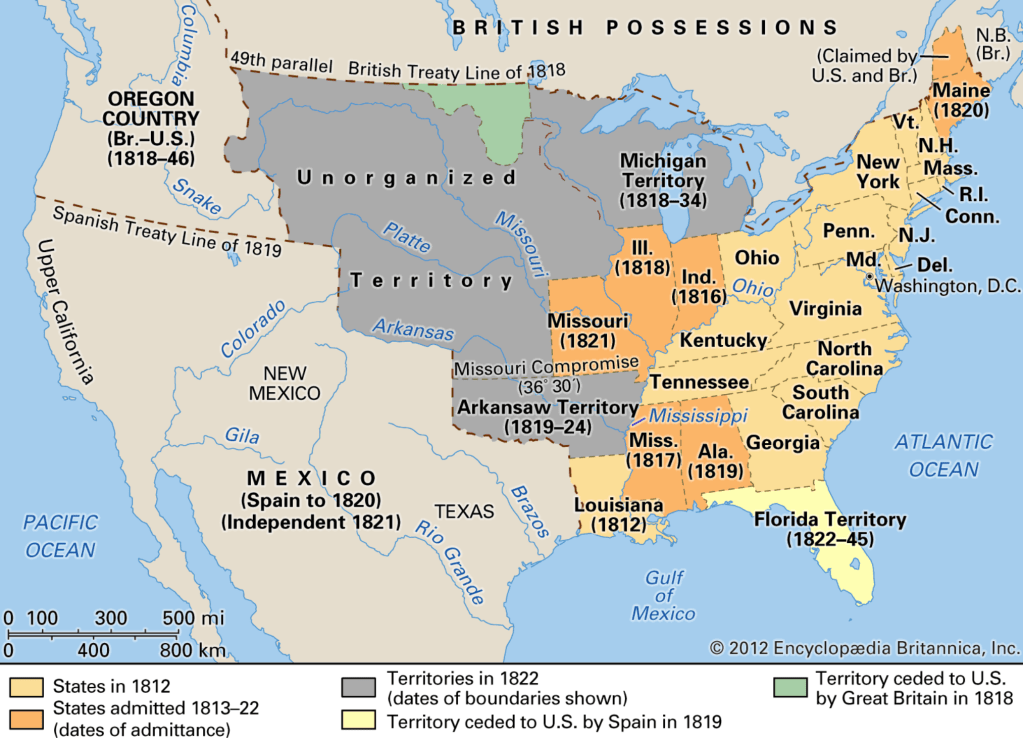
After the War of 1812, a map of the United States looked like this:
Why does any of this matter today?

History shows us that when given a choice to exert control over groups of people who are different or treat them with dignity and respect, the usual path is to exert control over them. Americans are most likely to “shoot first, and ask questions later.” When encountering conflict, history begs us to slow down. An old lawyer said to me once, “Act in Haste. Repent at Leisure.” Our individual and collective egos propel us into “fight or flight mode,” making quick and emotional decisions without thinking things through. A decision made quickly on a complex matter more often than not leads to unnecessary suffering.

How America has treated the First People and other non-White people matters. At a minimum, white Americans must acknowledge the collective sins of our past without qualification. As a society, we can no longer gloss over it all and pretend that we are color blind. It is easy to shrug our shoulders and say, “what happened in the past belongs in the past. Leave it there.” But the past really isn’t ever totally in the past. The consequences of the past are still with us today in the form of discrimination and an uneven playing field among Americans. We have a moral responsibility to face this reality.

“Grandfather, Look at our brokenness. We know that in all creation only the human family has strayed from the sacred way.  We know that we are the ones who are divided and we are the ones who must come back together to walk in the sacred way. Grandfather, Sacred One, Teach us love, compassion and honour that we may heal the Earth and each other.” – Art Solomon, Anishinabe Elder

In the next post, I will pick up the story, when the Americans square off against a band of Ojibwe a few years after the War of 1812, and O-sha-gus-co-day-way-quay, daughter of Waub-o-jeeg, chief of the Ojibwe band of Chequamegon Bay on Wisconsin’s north shore, intervenes and narrowly averts violence between the Ojibwe and the Americans at Sault St. Marie in Michigan’s upper peninsula.

“Live every day as if it’s going to be your last, and one day, you’ll be right.” – Malachy McCourt

Much of January of this year for me is a black box. It is very reminiscent of this SNL sketch with Tom Hanks. I can remember some things vividly, like getting wheeled in for a CT scan of my brain at 1 AM in the hospital after my first DBS surgery. I also remember being woken up for neurology checks all night long. “Mr. Andersson, can you push against me with your right foot? Push!  Now, pull away from me with your right foot. Pull!” I have no recollection of other things, like the fall and two seizures I experienced soon after arriving home, the corresponding ambulance rides to the emergency room, the additional scans and tests, and numerous conversations with various doctors and nurses. The notes are all there in my electronic medical record, but there are considerable gaps in what I can recall. Yet I know what essentially happened. I can see the dent in the drywall next to my bed, which my head made.

After coming home from the hospital, I have no recollection of watching Ken Burns’s ten-episode series on the Civil War with Annika and Malin, though I have seen pictures of me sleeping in front of the TV while it was playing. I also have no recollection of the homemade shortbread cookies that a dear friend dropped off. I am told that I raved about them and consumed them in massive quantities until they were gone. I vaguely remember being quizzed by Jennifer and the girls from time-to-time to see what little information I could retain. This experience for them must have been in equal parts hilarious and distressing. Finally, I also vaguely recall “using” the walker that the neurologist ordered to assist with my ambulation. I would simply pick up the walker and zoom all around the house at takeoff velocity, occasionally knocking pictures off the wall, which I still sometimes do. Boom! Crash! Here comes the papa!

My takeaway conclusion from this unusual experience is this: the list of things I need to be happy is much shorter than I previously thought. To be content, I need:

– family

– friends

– health insurance

– a roof over my head

– food and water

– some clothes

– a computer

– Wi-Fi

I have literally stumbled upon the essence of life. As Richard Rohr puts it:

At this stage, I no longer have to prove that . . . my group is the best, that my ethnicity is superior, that my religion is the only one that God loves, or that my role and place in society deserve superior treatment. I am not preoccupied with collecting more goods and services; quite simply, my desire and effort – every day – is to pay back, to give back to the world a bit of what I have received. I now realize that I have been gratuitously given to – from the universe, from society, and from God. I try now, as Elizabeth Seton said, to “live simply so that others can simply live.” Rohr, Richard. Falling Upward (p. 121). Wiley. Kindle Edition.

Deep Brain Stimulation

I am happy to report that I am starting to enjoy the benefits of DBS. It promises to improve the management of my symptoms and improve the quality of my life in meaningful ways. And I have a remote control for my brain. How cool is that!?

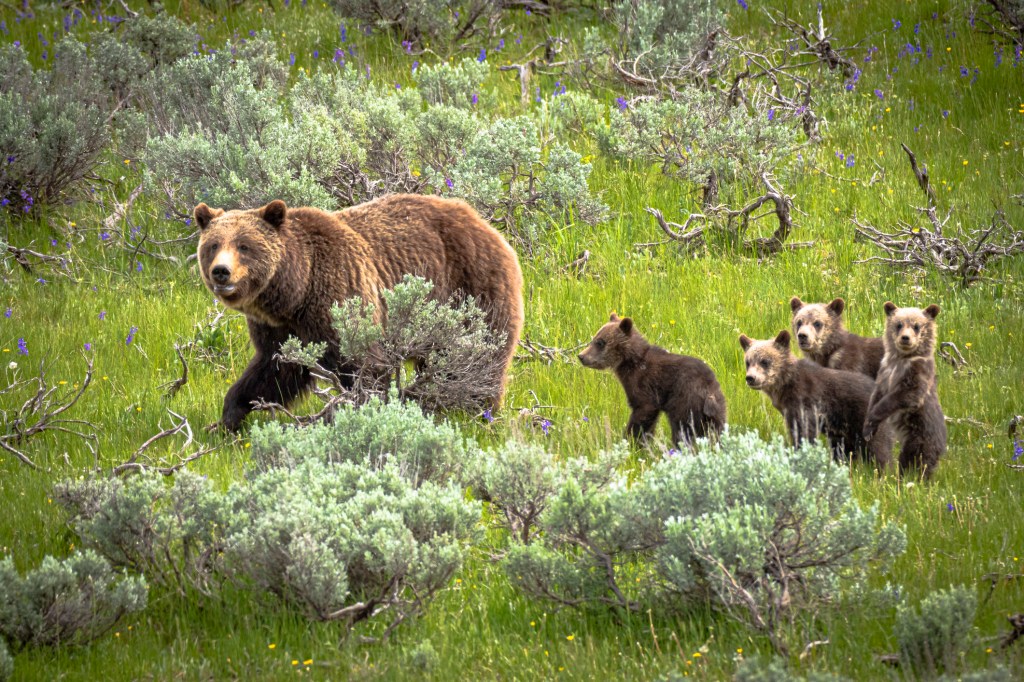
Grizzly Bear #399 and her four cubs (July 2020)

“We are not the survival of the fittest; we are the survival of the nurtured.” Louis Cozolino

Grizzly Bear #399, arguably the most famous grizzly bear of all time, makes her home in and around Grand Teton National Park. #399 is an intelligent mama bear. She is also quite adept at raising bear cubs – at least 22 bears are descended from her. Much to the delight of her many fans, #399 emerged from hibernation last spring with four baby cubs. This is an unusual achievement for any bear, much less a bear that is 24-years old. The cubs will remain with #399 for two years, during which time she will protect them and teach them how to survive in the wilderness.

Recently, #399 and her cubs have been busy foraging for food and consuming massive amounts of calories (hyperphagia) in anticipation of the coming winter season. #399 will soon dig a custom den for the group in the Tetons, and they will climb in together and sleep until sometime in April, without eating or drinking or leaving their den. Hibernation is a wonder of nature, and there is much that scientists do not understand about it.

To survive, bear cubs need an extraordinary amount of nurturing from their mama bears. At first, they need her milk, but they also need to be shown how to hunt, fish, forage and live in a harsh and dangerous mountain environment. Much like bears, human beings also need to be nurtured. The reality is, however, that all parents have limitations. None of us gets exactly what we need. The instructions we receive as children contain flawed bits of code that later limit our ability to function and be content with our place in the world. To grow, we need to find a way to be nurtured through our pain and trauma.

Nurturing through the Pain

Bouncing across the surface of life, the chaos in my brain often won’t allow my mind to settle. I slowly open my plastic pillbox. I fish out two little yellow L-dopa tablets with the fingers of my left hand and deliver the pills unceremoniously to my mouth. An hour or two from now, my tremor and anxiety will disappear completely, like magic. I will feel normal for a while. Then the cycle will repeat. It is all as predictable as the changing of the palace guard at Buckingham Palace. By the end of each day, I am exhausted.

My once-ubiquitous smile seems a bit harder to find lately. During dinner the other night, Annika was telling a joke. After she delivered the punchline, Jennifer turned to me with a look of concern and asked me if I was okay. I was apparently not smiling. Oh, crap. When did that symptom appear? Hypomimia (facial masking). Add that to the list.

I am a bit frustrated these days. I sense a low-grade, persistent anger swirling just below the surface. At times I have been angry with God. Many times I have been angry with myself. Many times I have been angry with people and institutions about a whole bunch of stuff. The current political climate is not helping the situation. The news I consume every day serves merely to perpetuate my frustration.

I’m aware that anger, like all feelings, is neither good nor bad. It simply needs to be processed. So, every morning, I sit on my yoga mat, breathing, and doing my best to quiet my frenetic mind. I place my hand over my heart, inhaling slowly through my nose, exhaling the same way. Along with my breathing, I meditate. There are many forms of meditation, but the RAIN format has been simple for me to remember and practice:

The four steps of RAIN—Recognize, Allow, Investigate, Nurture—will be our tool for arriving in presence. Simply put, RAIN awakens mindfulness and compassion, applies them to the places where we are stuck, and untangles emotional suffering. It is easy to learn the basics, and you can begin to use the steps right away. RAIN creates a clearing in the dense forest, and in this clearing you can recover your full heart and spirit. Brach, Tara. Radical Compassion (p. 4). Penguin Publishing Group. Kindle Edition.

Recognize

As you reflect on this situation, ask yourself, “What is happening inside me right now?” What sensations are you most aware of? What emotions? Is your mind filled with churning thoughts? Take a moment to become aware of whatever is predominant, or the overall emotional tone of the situation. Brach, Tara. Radical Compassion (p. 43). Penguin Publishing Group. Kindle Edition.

Allow

Allowing, the next step, asks you to “let be” whatever thoughts, emotions, feelings, or sensations you have just recognized. You initiate it by gently asking, “Can I be with this?” or “Can I let this be?” It’s natural to feel resistance at this point—you wish some of those feelings would go away! Allowing can include the reality of your “no”—the fact that you really hate the way you’re feeling. Pause as the thoughts and emotions continue to unfold, without trying to control them or doing anything to resolve them. You may feel a strong urge to start analyzing and fixing things. You need to let that be as well. This is a time to let your awareness include everything that is going on inside you. Brach, Tara. Radical Compassion (pp. 25-26). Penguin Publishing Group. Kindle Edition.

Investigate

Bring an interested and kind attention to your experience. Some of the following questions may be helpful. Feel free to experiment with them, varying the sequence and content. What is the worst part of this; what most wants my attention? What is the most difficult/painful thing I am believing? What emotions does this bring up (fear, anger, grief)? Where are my feelings about this strongest in my body? (Note: It’s helpful to scan the throat, chest, and belly.) What are the feelings like (that is, the felt sense or sensations, such as clenched, raw, hot)? When I assume the facial expression and body posture that best reflect these feelings and emotions, what do I notice? Are these feelings familiar, something I’ve experienced earlier in my life? If the most vulnerable hurting part of me could communicate, what would it express (words, feelings, images)? How does this part want me to be with it? What does this part most need (from me or from some larger source of love and wisdom)? Brach, Tara. Radical Compassion (pp. 43-44). Penguin Publishing Group. Kindle Edition.

Nurture

As you sense what is needed, what is your natural response? Calling on the most wise and compassionate part of your being, you might offer yourself a loving message or send a tender embrace inward. You might gently place your hand on your heart. You might visualize a young part of you surrounded in soft, luminous light. You might imagine someone you trust—a parent or pet, a teacher or spiritual figure—holding you with love. Feel free to experiment with ways of befriending your inner life—whether through words or touch, images or energy. Discover what best allows you to feel nurturing, what best allows the part of you that is most vulnerable to feel loved, seen, and/or safe. Spend as much time as you need, offering care inwardly and letting it be received. Brach, Tara. Radical Compassion (p. 45). Penguin Publishing Group. Kindle Edition.

I will be honest. The element of nurturing with self-compassion does not come easily for me. My historic script of self-talk has been more like: “here is a catalog of the mistakes you have made in your life, which, combined with your other inadequacies, make you less worthy than others.” My inner boss has the memory of an elephant. Yet, I am aware that finding a kinder, gentler voice inside of me is the key to experiencing a measure of true peace in the present moment. Instead of wallowing in the shame of negative thoughts, I flip the script whenever I can remember and focus on the positive:

Each of us can learn to Nurture our inner resources, to discover our fearless heart in the face of fear. Our resource anchors may be very different—bringing to mind a trusted friend or a spiritual figure, leaning against a tree, touching our own heart, holding a rock. Yet if we offer our full attention to the positive inner state they awaken, we are directly Nurturing a tender presence that can hold our life. Brach, Tara. Radical Compassion (p. 107). Penguin Publishing Group. Kindle Edition.

Quieting my busy mind, I let it rain. I pray for me. I pray for you. Bringing to mind a nurturing presence, my prayer is simple: May you be well. May you be happy. May you be free from suffering.

Norway Maple Tree in October

“Only if you resist what happens are you at the mercy of what happens, and the world will determine your happiness and unhappiness.” – Eckhart Tolle

The weather this fall in Michigan has been outstanding. The trees seem to have been given extra time to display their yellow, red, and orange leaves in one last spectacular flourish before their inevitable descent and reunion with the earth. Autumn is an excellent reminder of the endless cycle of birth, growth, life, transition, and death.

On a recent sunny afternoon, I made my annual pilgrimage to a nearby cider mill to buy fresh apple cider and hot donuts. Standing in line, I decided to pay for the cider first and then retrieve it. Cider is heavy, and my medication was in the “off” phase, which means that the tremor on the right side of my body was causing me to perform my usual involuntary jig. At the register, the friendly clerk noticed what was happening and retrieved two gallons of cider for me. She cheerfully asked, “would you like some help getting these to your car?” I smiled and nearly accepted her offer, but then I instinctively said, “no, thanks, I think I can manage.” I somehow got the cider and two dozen donuts to the car without dropping anything. I plopped down into the driver’s seat, contemplating my situation. I devoured three donuts in quick succession like a beaver happily munching branches from a birch tree that he managed to topple to the ground near his underwater lodge.

Living with Parkinson disease makes life a bit complicated. I am always on the lookout for ways to simplify how I get things done. A great example is in my wardrobe. I no longer wear starched button-down shirts, colorful bowties, sport coats, skinny jeans, and chucks. Today you will find me wearing comfy joggers, T-shirts, pullover sweatshirts, and hiking shoes. My fancy espresso equipment has been moved to a box in the garage for storage. Now when I make coffee, it’s instant and almost always decaf. I know, right? Alcohol in any form is also off the menu – it makes my symptoms worse it is not a healthy choice for me anyway. Finally, I am much more mindful about when and what I eat. I take copious amounts of levodopa each day to create a workable amount of dopamine in my brain. The consumption of protein cancels out my levodopa, which reactivates my tremor.

The reality is that, like every other sentient being on this planet, I am facing some losses amidst the many joys in life. When we face loss, each of us has a choice about where to cast our vision. If we look to the left or to the right, we find ourselves focusing on the people and things around us, measuring our life’s value based upon how we perceive others to be doing compared to ourselves. No one ever wins at this game. There is always someone doing better by the usual American measures of income, possessions, and lifestyle. Even if we happen to be “winning” at the moment, the anxiety caused by our never-ending parade of mental comparisons does not go away. It is simply replaced by a fear of losing whatever money, power, or social status we have managed to accumulate through hard work, grit, and fortitude. As anyone who has witnessed a toddler protecting a toy from other toddlers can readily attest, it is human nature to grasp our beloved things jealously. Everything seems to be under constant threat of being taken away, which is, in fact, true. Everything in this world is temporary, and it is all over in the blink of an eye.

We can, however, change our perspective at any time. Raising our gaze, our eyes turn in the direction of the stars, our galaxy, and the galaxies beyond. Deeper and more profound questions quietly bubble to the surface. Why am I here on this planet? What can I do today that will make an actual difference? Who will be my companions on this journey? What will be my legacy when I’m gone? What am I holding onto that needs to be cast aside? What  can I do to change my focus? If we want different answers from life, we can start by raising our gaze and asking different questions.

Curious George

When I was in the third grade, I performed major surgery on my favorite stuffed animal, Curious George. He had a string on his back. When pulled, the string would cause him to recite one of six cheery phrases, including: “I’m Soft and Cuddly, I’m a Little Monkey, I’m Curious George, I’m a Curious Monkey, I Learn new things, and Let’s Count…1, 2, 3.”  George’s curiosity was contagious, and I began to wonder how it was that he was able to talk. Alone in my bedroom upstairs, I decided to perform surgery. I retrieved my mom’s sewing scissors and prepared for the procedure. After administering pretend anesthesia, I carefully removed a mechanical box from George’s body, closing the wound with safety pins. I then set about examining the little tin box of wonder. This involved my smashing it with a hammer.

When I was in the fourth grade, I visited my friend, Brent. He lived down the street. His dad was a hunter (or at least he had guns). One day we were playing with our G.I. Joe and Big Jim action figures in the living room. We came upon a box of live ammunition. I was super curious about it. I persuaded Brent, who was reluctant at first, to give me a round of live .22 caliber ammunition. I hurried away from his house with my little, shiny-metal treasure in my hand and headed straight home. As soon as I got there, I went down to our basement and excitedly set out to take apart the object for examination. I grabbed a hammer from my dad’s toolbox, placed the round on the concrete floor, and began to pound. You already know what came next. On the second hit, the hammer lit the primer, igniting the gunpowder and sending a .22 caliber lead slug whizzing through the air near my head. The wooden ceiling in our basement stopped the bullet with a thud, and dust fell from the beam where it lodged. I looked up. Then I looked down in horror at the now empty, smoking brass casing. My heart nearly pounded out of my chest. I ran up the stairs, through the back door, and out into our backyard. What had just happened? After lying on my back and looking up at the clouds, my heartbeat eventually began beating normally again. I returned to the basement, threw away the shell casing, and went about my business. I told no one about what had happened that day. I didn’t want to get in trouble. There were very few adults I trusted. I had my reasons.

Dazed and Confused

When I was growing up, corporal punishment for perceived disciplinary infractions was accepted and even celebrated. Surprisingly, it still appears to be allowed as a matter of law in 19 states. My fourth-grade teacher in elementary school showed off his wooden paddle in front of the class at the beginning of the school year. He explained to us how its holes made the paddle travel faster through the air on its way to the recipient’s rear end. It was all a big joke until it wasn’t. My teacher would occasionally lose his temper. His chin would tremble as he pounded the chalkboard with his fist and shouted, “Damn it!” But he was far from the worst.

Our school principal was a petty tyrant with a strong streak of cruelty. On two separate occasions, he swooped in silently like an owl snatching a vole from a meadow in the dark of night, grabbing me by the short hairs on the back of my head and dragging me back to his office, where, after placing my hands on his desk, he struck me with his wooden paddle. I was too frightened and confused even to try and defend myself. My face turned red, and I felt humiliated. For the record, despite what the other boys said, I was not a participant in the cheese stick smashing ritual at lunch. In fact, I moved to another table when the smashing started to avoid any trouble. In the other incident, while I was being dragged to the principal’s office, I wish I could have told him that Ricky was grabbing my enameled Lassie belt buckle while we were riding the merry-go-round, which is why I was leaning out over the edge. It wasn’t my fault! Nevertheless, I remained silent like a lamb on the way to slaughter. Once again, I felt deeply ashamed. I was already suspicious of adults, and these incidents made me even warier. I did not dare to inform my parents about what had happened, because I did not trust how they would respond. It is equally plausible that I simply did not know what to say.

My principal’s unexpected paddling caused me untold suffering as a young boy:

When a person experiences a trauma, the left anterior frontal lobe known as Broca’s area—the language part of the brain—is deactivated. This deactivation of Broca’s area causes “speechless terror” for many traumatized people and they can’t talk about or understand their experience with words. They feel intense emotions without being able to put a label on what they are experiencing. Parnell, Laurel. A Therapist’s Guide to EMDR: Tools and Techniques for Successful Treatment (p. 17). W. W. Norton & Company. Kindle Edition.

From these incidents and other traumatic events involving shaming by others in public, I conditioned myself not to trust anyone in a position of authority. Unresolved trauma can lead to posttraumatic stress disorder (PTSD). Symptoms of PTSD vary and can range from mild to completely disabling. In my case, PTSD has taken the form of an unhealthy, codependent need to please others, a tendency to isolate and keep myself at a safe distance from others, and difficulty letting my guard down to enjoy life.

PTSD is unusually persistent:

People with PTSD have more active limbic systems and ordinary talk psychotherapy does not decondition the limbic system. The part of the brain that holds the traumatic memory continues to be triggered, acting as if present-time nonthreatening internal or external stimuli are dangerous, even if they understand that the stimuli are not dangerous and the reasons for their responses. They still have the same somatosensory or emotional responses to the old cues. You can’t reason the body out of reacting to stimuli that causes a reaction in the limbic system. Stimulation of this part of the brain causes a nonverbal response that is not changed by intellectual understanding. The limbic system continues to respond as if there were present dangers (van der Kolk, 1994). This is why so many clients who have been abused as children or traumatized as adults do not change their behavioral responses to triggers even after years of insight-oriented psychotherapy. Parnell, Laurel. A Therapist’s Guide to EMDR: Tools and Techniques for Successful Treatment (p. 17). W. W. Norton & Company. Kindle Edition.

There is some goods news here. EMDR (Eye Movement Desensitization and Reprocessing) therapy was developed specifically for people dealing with PTSD. It first became popular, treating soldiers returning from combat. The VA endorses it as an effective treatment for PTSD. If you think you may have PTSD, or if you know someone who is dealing (or not dealing) with it, I encourage you to consider finding a therapist with expertise in EMDR. The harm caused by traumatic experiences can be healed. It is never too late.

“Courage starts with showing up and letting ourselves be seen.”— Brene Brown

Abandoned plumbing at White Deer Lake

“If there ever comes a day when we can’t be together, keep me in your heart, I’ll stay there forever.” — Winnie the Pooh

I love the simplicity of hiking in the back country. After a grueling day on a demanding trail, I find a campsite, pitch my tent and cook something simple for dinner. When the sun goes down, I climb into my sleeping bag and go to sleep. When the sun comes up, I get up, eat breakfast, pack up my things, and start hiking. I frequently stop to check my map so that I know where I am and where I am heading. A wrong turn can be time-consuming and potentially dangerous. It’s always more fun to hike with family or friends, but I’m not opposed to hiking solo with appropriate safety precautions.

I recently went on a backpacking trip in the McCormick Wilderness. It comprises 17,000 acres of pristine boreal forest, streams, wetlands, and small lakes in Michigan’s upper peninsula. The McCormick Wilderness is in bear country, though black bears in the upper peninsula are wary of humans and far less dangerous than their grizzly or Alaskan brown bear cousins – so I wasn’t too worried.

Beginning in the year 1906, Cyrus Hall McCormick II, a wealthy industrialist from Chicago, spent enormous sums building a grand camp at White Deer Lake in this wilderness. By the mid-1940s, the Camp consisted of seventeen log buildings, miles of boardwalk trails, canals, a dam to regulate the lake level, plumbing, an electrical system, a floating tennis court, a French chef, and an English butler. The Camp’s many visitors included Henry Ford and Harvey Firestone. They enjoyed all that the wilderness has to offer plus a surprising number of modern luxuries.

All that remains today of the Camp are cement building foundations in various states of collapse, an abandoned plumbing system, and some wooden pilings that once secured a small ferry boat that connected the mainland to the island. The many visitors to the grand Camp at White Deer Lake have long since passed on. Their vivid memories from this unique place have vanished forever.

Gone also are the intense discussions about the manufacture and sale of tractors, the market price of a share of common stock in International Harvester Company, America’s involvement World War I, the best strategy for dealing with the flu pandemic of 1918, the stock market crash of 1929, the Great Depression, and World War II. Apart from the blowing of the wind, an occasional loon singing, squirrel chattering, or dragonfly buzzing, White Deer Lake is now completely silent.

In Psalm 90, Moses wrote the following prayer, “Teach us to number our days, that we may gain a heart of wisdom.” From what I have read about Cyrus Hall McCormick II, he seemed to have learned this critical lesson late in life:

[He] became more withdrawn and contemplative. His wife died and he married his secretary, to the consternation of the international social circles in which he traveled. Then came a series of family embarrassments culminating in his brother’s well-publicized and medically avant-garde experiment with a gland transplant operation. The procedure was intended to improve the brother’s sexual prowess while he pursued a Polish opera singer. The donor was a monkey from Chicago’s Lincoln Park Zoo.

The wistful McCormick, contemplating human sadness and fatuity, liked to stroll short distances to favorite spots on the property and sit for hours as an observer. One day, his eyes were captured by a glacial boulder, covered with moss and sprouting oak ferns and wildflowers in its crevices. He remembered how his first wife, Harriet, liked to sit by this boulder, looking out across the lake, in the early days of the Camp. It had been one of her favorite places. He decided to have the boulder moved to the family cemetery plot in Chicago as a memorial to her. The rock weighed 24 tons. Nine bridges had to be shored up with temporary pilings as the boulder was dragged by a fleet of International Harvester supertractors down the Peshekee River grade to the town of Champion. From there, a special train hauled the boulder, now wrapped in wet burlap to preserve its delicate flora, to Chicago. The monument now rests in Graceland Cemetery, mossless, fernless, flowerless—mostly buried—and barely noticeable beneath a thicket of yews. A few hundred feet away, on an island in the middle of an artificial pond, surrounded by willows, stands a Grecian temple with the name “McCormick” inscribed on its entablature. “Rough Camp,” the Rise and Fall of a “Great Camp” in Michigan’s North Woods.

For a man who had acquired the finest things that money could buy, McCormick’s heart was aching. As he gazed across White Deer Lake in his final season of life, I wonder whether he thought about how different his life could have been.

Gordon McCormick, the son of Cyrus McCormick, bequeathed White Deer Lake and the surrounding wilderness to the U.S. Forest Service upon his death in 1967. It had been neglected for many years. In 1984, Richard Hendricksen, a self-styled “failed real estate developer,” from Manistee, Michigan, submitted a successful bid to the Forest Service to purchase and remove all of the wooden structures from White Deer Lake for the sum of $50. It took him two years to finish his work. When he was done, the U.S. Army Corps of Engineers used dynamite to explode the chimneys, which were still standing. Then they burned everything to the ground.

Sitting on a rocky bluff overlooking White Deer Lake, which McCormick is said to have loved, time seemed to stand still. I walked around the remains of the Camp quietly and slowly and tried to make sense of it all. The things that captured my attention were not urgent. But they were profound. I felt grateful and alive as I sat on my rocky perch in the afternoon sun. Life is precious, and my visit to White Deer Lake reminded me that I will only be here for a moment. I lifted my backpack onto my shoulders and climbed the trail leading back to where I had started. I couldn’t wait to get back home.

“Unless you build your first house well, you will never leave it. To build your house well is, ironically, to be nudged beyond its doors.” ­ – Richard Rohr

For historic pictures and more information, check out “Rough Camp,” the Rise and Fall of a “Great Camp” in Michigan’s North Woods.

Foundation of large structure on shoreline of White Deer Lake

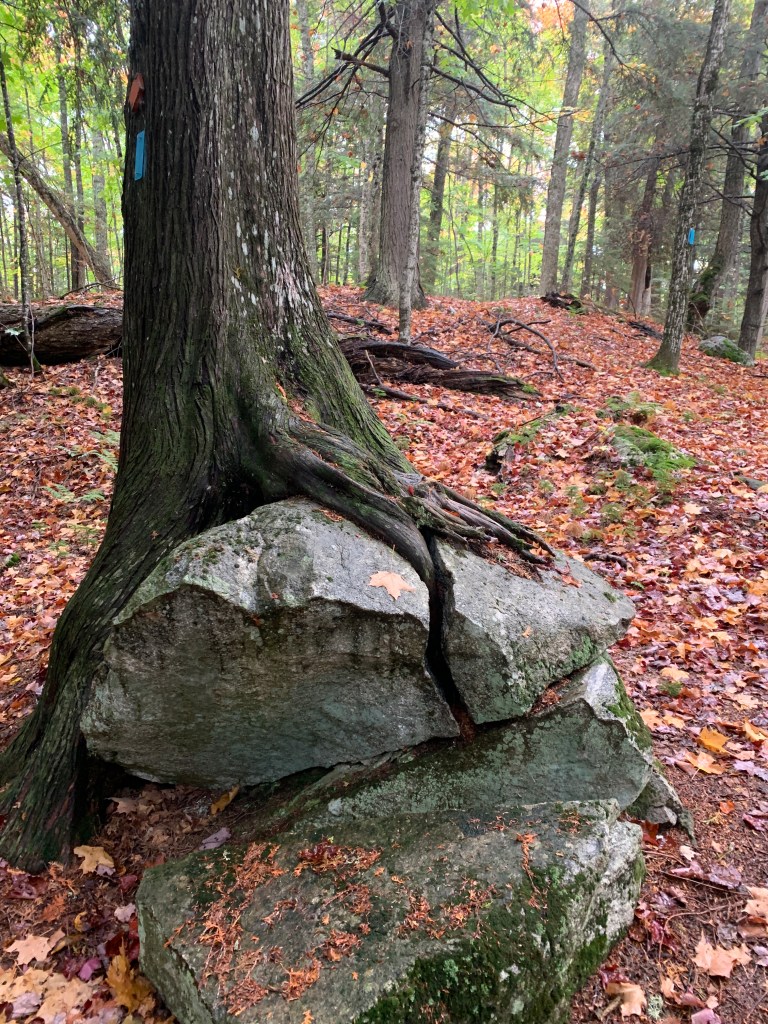
North Country Trail in Craig Lake State Park in the upper peninsula of Michigan

“Whatever you fight, you strengthen, and what you resist, persists.” – Eckhart Tolle

At times throughout each day, my brain is a jumble of energy. Many of the cells in my brain that used to produce dopamine no longer function. My brain tries to compensate by working harder, but the system is no longer intact. The messages that rely on dopamine cannot get through. I take medicine to stop my tremors, but it takes time to work and lasts for only so long. When it wears off, my brain reverts to its frenetic state.

When each new cycle of shaking begins, my immediate instinct is to resist it. Fighting, however, only makes me suffer. It is always better when I can try and find a way to let go and wait out the storm. I’m not talking about giving up. Giving up and choosing to let go are not the same. The first is passive and implies defeat. The second is active and involves non-resistance to what is real.

Two Choices

Roadblocks and setbacks occur in the journey of life. Relationships fail. Accidents happen. A pandemic arises. People get sick. People lose their jobs. The economy falters. When life happens, the response we choose tells us everything we need to know about our spiritual condition. We have two choices. We can accept the reality of the moment, or we can let our ego take over, swinging our fists in the dark at everything that we perceive as wrong.

Accepting the reality of life with Parkinson disease has been a long journey. I am not the same person as I was before. This is good news. For many years I worked in a tall building in downtown Detroit. My office was on the 23rd floor. It had a spectacular view overlooking the Detroit River. When I entered the elevator to leave our floor, I would secretly press and hold down the “L” button continuously, because I read somewhere that this would cause the elevator to skip past all other floors and go straight to the lobby. It was like I was saying: “Hi, Mr. Elevator, just so you know, I am special and important and would appreciate it if you would deliver me to the lobby without stopping at any other floors, even if other people are waiting. I am in a huge hurry. Did I mention to you that I am a partner in this fine law firm?”

Back in the prime of my career, I could be such an asshole. For those that worked with me or knew me in my younger years when I was in this mode, I am so sorry!

Not Doing Anything

My life is so much different now. On many days, I look at my Apple Watch, which tells me: “No more events. Your day is clear.” I do my best to lean into my situation and smile about the significant parts – and there are many. I am learning, slowly, to find contentment in the moments when I am not doing anything at all.

The truth is that my life is worthwhile, even when I cannot sit still at the computer, hold a pencil, open a package, or carry on a conversation with ease. As long as my heart is beating, I can choose to let go of whatever I am holding (or not holding). I encourage myself to be patient and wait. Sooner or later, my shaking will stop, and peace will arise in my mind, body, and spirit. I can look forward to and celebrate these moments as the gifts that they represent. I take nothing for granted.

The Words that Come to Mind

It is mind-boggling to try and comprehend the chaos that the novel Coronavirus has unleashed upon the world. Joseph Stalin famously said: “The death of one man is a tragedy; the death of millions is a statistic.” It is impossible to fully grasp the social, political, and economic consequences of the Coronavirus. Every day, the virus seems to throw us a new curveball. It shows no sign of stopping anytime soon. With everything that is happening, it is not easy to be optimistic. Our politicians are sneering and flailing. Our country continues to fracture into more defiant tribes. Our country seems to be out of work and out of fresh ideas. We are continuously bombarded in the 24-hour news cycle with stories that make us sigh, groan, click and take offense at something, somewhere, that someone else is doing. It is super addictive and mostly serves to reinforce our tendency toward narcissism.

Fortunately, there is a pathway to greater peace. It is surprisingly within reach. It begins when I decide to step outside of the chaos in my mind and the world. I can choose quietly, many times throughout each day, to not allow myself to get sucked into the vortex. For me, this often involves putting my devices to sleep and taking a walk outside, or a bike ride, or a swim. In my more enlightened moments, it means walking into the next room to hug Jennifer or one of our girls, or scratch the ears of our beloved dog, Freja, and smile and connect. When I choose the pathway of peace, my grip loosens, and I enter a world where we are all connected. In this world, love and acceptance are the only words that come to mind.

“When you lose touch with inner stillness, you lose touch with yourself. When you lose touch with yourself, you lose yourself in the world.” – Eckhart Tolle

“Resentment is like taking poison and waiting for the other person to die.” ­– Malachy McCourt

I learned when I was a boy to be hypervigilant and wary of authority figures in my life. There was just enough unpredictability and chaos in my family life to make me suspicious of people in positions of power. When my parents acted in ways that seemed to me to be arbitrary, I became frustrated and anxious.

The Origin of Resentment

I appreciate Eckhart Tolle’s description of childhood pain:

Any negative emotion that is not fully faced and seen for what it is in the moment it arises does not completely dissolve. It leaves behind a remnant of pain. Children, in particular, find strong negative emotions too overwhelming to cope with and tend to try not to feel them. In the absence of a fully conscious adult who guides them with love and compassionate understanding into facing the emotion directly, choosing not to feel it is indeed the only option for the child at that time. Unfortunately, that early defense mechanism usually remains in place when the child becomes an adult. The emotion still lives in him or her unrecognized and manifests indirectly, for example, as anxiety, anger, outbursts of violence, a mood, or even as a physical illness.

The remnants of pain left behind by every strong negative emotion that is not fully faced, accepted, and then let go of joining together to form an energy field that lives in the very cells of your body. It consists not just of childhood pain, but also painful emotions that were added to it later in adolescence and during your adult life, much of it created by the voice of the ego. It is the emotional pain that is your unavoidable companion when a false sense of self is the basis of your life. This energy field of old but still very-much-alive emotion that lives in almost every human being is the pain-body. Tolle, Eckhart. A New Earth (Oprah #61): Awakening to Your Life’s Purpose (pp. 156-158).

A Flash of Anger

Anger is an emotion that serves an essential but limited function. In the wilderness, anger arises automatically in response to a physical threat. An approaching wild animal activates the fight or flight mechanism in our brains, causing physiological changes in our bodies that are optimized to help us survive. We can easily observe this process in nature, where conflicts among wild animals are intense and awe-inspiring, but always short-lived. Conflict in the wild leads to death, injury, or, more often than not, withdrawal and de-escalation.

Our modern world has added enormous complexity and power to this natural process. We now face external stimuli that our brains perceive as threatening in ways that we have not sufficiently evolved to handle. Indeed, it is increasingly common to allow our minds to be hijacked perpetually by external stimuli. Many of us access social media and the news media from moment to moment, or at least hour to hour, across multiple devices and channels. Our brains swim in a toxic sea of adrenaline, cortisol, and sugar. Our heart rate rises and stays elevated. We are stressed out. A third of Americans (that translates to approximately 108.6 million people) now show signs of clinical anxiety and depression, according to a recent study by the CDC.

When I am in fight or flight mode, I carefully curate my list of arguments proving why I am right about everything. I conquer my enemies in my imagination, where I win 100% of the time. Resentment is like rocket fuel, igniting my ego’s powerful engines and propelling me into oblivion at escape velocity.

I was not meant to live this way. Indeed, in my faith tradition, I was taught never to let the sun go down on my anger.

“Righteous” Anger

American culture values individual freedom above all else. Our heritage as an obstinate nation dates back to the Revolutionary War, where, with the help of the French, we threw off the shackles of King George. Later, we fought a civil war to settle, once and for all, whether we could prohibit our fellow citizens from buying, selling, using, and enslaving other human beings, upon which the southern economy was founded. We are still fighting the Civil War today in so many ways.

The American spirit is a resentful  one. Americans bristle against being told that some words and symbols are not socially acceptable. Many Americans hate being told that they must shelter in place or wear a mask in public. In my home state of Michigan, protestors of Governor Whitmer’s stay-at-home orders, carrying assault rifles, shouted at police and heckled lawmakers from the spectator gallery in the senate chamber.

It is ironic that, despite our reluctance to be governed, our country has repeatedly appointed itself as the guarantor of freedom and democracy in the world. We have muscled our way into numerous armed conflicts based upon assumptions that, in retrospect, turned out to be completely wrong. With some notable exceptions, we have sent our soldiers to many places where their presence was neither necessary nor appropriate. After causing massive destruction, they have most often retreated from the theater of war without having established either freedom or democracy.

Our national propensity to violence also plays out on an individual level. We confuse resentments as “righteous” anger. In the inspiring book, Unoffendable, Brant Hansen offers divine wisdom about the proper context of anger in the context of modern Christianity.

Here’s what I think, given that we’re to “get rid of all anger”: Anger will happen; we’re human. But we can’t keep it. Like the Reverend [Martin Luther] King, we can recognize injustice, grieve it, and act against it—but without rage, without malice, and without anger. We have enough motivation, I hope, to defend the defenseless and protect the vulnerable, without needing anger. Seek justice; love mercy. You don’t have to be angry to do that. People say we have to get angry to fight injustice, but I’ve noticed that the best police officers don’t do their jobs in anger. The best soldiers don’t function out of anger. Anger does not enhance judgment. Hansen, Brant. Unoffendable (p. 8). Kindle Edition.

Hansen goes on:

Being offended is a tiring business. Letting things go gives you energy. And while I thought the idea of choosing to be “unoffendable” was ludicrous, I’ve tried it. And I’m not perfect at it, but I’m much, much better than I used to be. I just let stuff go. I go into situations thinking, I’m not going to be offended. No matter what. I can let stuff go, because it’s not all about me. Simply reminding myself to refuse to take offense is a big part of the battle. Hansen, Brant. Unoffendable (pp. 12-13). Kindle Edition.

Importantly, God doesn’t need us or ask us to be angry on his behalf:

Yes, we all deal with crazy people. Judgmental people. People who believe, deep down, that their job, after being invited into the party that is the kingdom of God, is to keep others out of the party, and then pat themselves on the back for “taking a stand.” I hear from them often. Hansen, Brant. Unoffendable (p. 43). Kindle Edition.

Here is the truth of the matter:

War is not exceptional; peace is. Worry is not exceptional; trust is. Decay is not exceptional; restoration is. Anger is not exceptional; gratitude is. Selfishness is not exceptional; sacrifice is. Defensiveness is not exceptional; love is. And judgmentalism is not exceptional . . . But grace is. Hansen, Brant. Unoffendable (pp. 40-41). Kindle Edition.

The bottom line from all of this is that God is not calling me to be angry and to troll social media, pointing out the errors and shortcomings of everyone else. God is not calling us as a nation to send our armed forces around the world to cause “regime change” when a foreign government falls out of our favor. God is calling us to love and not hate. It is only by releasing anger, including the right to be offended, and taking the actions of love that we can make a positive difference in the world. This approach also provides the best path toward personal serenity. What would happen in our country – in our world – if we stop being offended and start looking for ways to bring people together to solve our common problems?

How I walk back from the ledge of resentment

A post like this is challenging to write because life is complicated. I have more questions than answers. I do not pretend to be an expert in the healing of resentments. For most of my life, I have been overly sensitive to criticism and prone to resentment.

All I can say is that, at this moment, when I find myself on edge or easily provoked, I choose to abstain from social media and news media for days or weeks at a time. Instead of pursuing the dopamine rush that accompanies my taking offense at some person or cause, I feel called to put down whatever I am holding (physically or metaphorically). I take a mental inventory of the many things in my life for which I am grateful. Peace begins quietly to take root in my heart and soul.

“Let us not seek to satisfy our thirst for freedom by drinking from the cup of bitterness and hatred.” – Martin Luther King Jr.

Confronting Racist Myths and Practices

You’ve got to be taught to hate and fear, you’ve got to be taught from year to year, its got to be drummed in your dear little ear, you’ve got to be carefully taught. . . . You’ve got to be taught before it’s too late, before you are six or seven or eight, to hate all the people your relatives hate, you’ve got to be carefully taught” – Oscar Hammerstein II

All human beings experience confirmation bias, which leads us to interpret new information in a way that confirms our existing beliefs. Confirmation bias is most pronounced in the case of ingrained, ideological, or emotionally charged views. Racial bias is a form of confirmation bias. Racial bias leads to all sorts of problems and perpetuates racist practices in America. Metro Detroit has been identified as the third most segregated city in America. I live in the City of Farmington, which is a suburb of Detroit. A retired police officer once told me that, in the 1980s, some officers would pull over a vehicle driven by a Black person and announce on the radio that they had stopped to pull over a “N.I.F.” I can only imagine what it felt like, and feels like now, to drive in the City of Farmington as a Black person.

I still know people in the suburbs who are afraid to drive to the City of Detroit and avoid going there. Headlines in the news and TV shows reinforce racial stereotypes, especially that Black males are dangerous criminals. It is said that if you tell a lie big enough and keep repeating it, people will eventually come to believe it. The lie of racial stereotypes gets passed down from generation to generation. It is insidious. Racial bias poisons the mind and, consequently, our national mentality. I am told that my grandfather thought Martin Luther King, Jr. was a “communist” and didn’t approve of him. I often heard my mother making racist statements about her various caregivers over the years. I grew up in a white suburban family where racial bias infected our thinking.

As a white American, I am choosing now to challenge my racial bias. As a first step I need to reject (or at least qualify) some deeply ingrained American myths. For example, despite what I have been taught about the American Dream, I need to accept that millions of people in this country do not have a meaningful opportunity to “pull themselves up by their boot straps.” Interestingly, this term first appeared in the 19th century as an example of a task that was impossible to perform.

Comparing the US with one high-mobility state (Denmark), journalist Kevin Drum concluded that lack of mobility for the poorest children in the United States seems to be the primary reason for America’s lag behind other developed countries. A study from the Economic Mobility Project found that growing up in a high-poverty neighborhood increases Americans’ risk of experiencing downward mobility and explains a sizable portion of the black-white downward mobility gap. The report’s analysis also showed that black children who experience a reduction in their neighborhood’s poverty rate have greater economic success in adulthood than black children who experience poverty rates that increase or are stable. Neighborhoods and the Black-White Mobility Gap.” Pew Charitable Trusts Economic Mobility Project.

In today’s hypercompetitive world, the reality is that the deck is stacked against the poor from the very beginning. This is especially true for Black Americans.

The typical black family has just 1/10th the wealth of the typical white one. In 1863, black Americans owned one-half of 1 percent of the national wealth. Today it’s just over 1.5 percent for roughly the same percentage of the overall population. Why the racial wealth gap persists, more than 150 years after emancipation.

These figures are heartbreaking. As a white American, I am a knowing or unknowing participant in a system in which racism continues and evolves over time.

Racism describes a system of power and oppression/advantage and disadvantage based on race. Structural racism is a system, or series of systems, in which institutional practices, laws, policies, social- cultural standards, and socio-political decisions establish and reinforce norms that perpetuate racial group inequities. Within the context of the United State of America, and other nations, structural racism takes the form of white supremacy; the preferential treatment, privilege, power, access, networks, and access to opportunities available to white people, which often designate communities of color to chronic adverse outcomes.” Anti-Oppression LibGuide: Anti-racist resources.

What can I do in my life to stop participating in this system? First, I must call out individual and systemic racism whenever and wherever I see it, especially when I see it within myself. This is challenging. Racial bias is not obvious. It hides below the surface of my consciousness.

On a conscious level, it is also difficult to confront racial bias. Social media platforms like Facebook are not designed to facilitate meaningful public discourse. Instead, they become powerful echo chambers of offense and rage. Thousands of bots flood Facebook and Twitter with disinformation, posing as real users. As anyone can attest, an hour spent consuming the news is more likely to harden our stance, making it all but impossible to have a rational dialogue with people that have a different perspective on what is happening. This takes us in the opposite direction of where we need to go. Social media is a breeding ground for resentment.

On a national level, there is no greater evidence of the dysfunction of our ability to communicate than Congress, where neither the left nor the right seem to be able to talk to each other and accomplish anything other than through power moves. The system is broken.

Changing Our Education System

Next, I must acknowledge and accept, without the usual caveats, that a lack of access by poor Americans to a quality education is a major contributing factor to the reality of racism in our country.

At virtually every level, education in America tends to perpetuate rather than compensate for existing inequalities. The reasons are threefold. First, the K through 12 education system is simply not very strong and thus is not an effective way to break the link between parental background and a child’s  eventual success. . . . Second, because K–12 education is financed largely at the state and local level, resources devoted to education are closely linked with where people live and with the property wealth of their neighbors. For this and other reasons, poor children tend to go to poor schools and more advantaged children to good schools. . . . Finally, access both to a quality preschool experience and to higher education continues to depend quite directly on family resources. 2006 Policy Brief of the Brookings Institution, Isabel Sawhill (2006:3).

In 2015, US students placed 38th out of 71 countries in math and 24th in science. Disadvantaged students in the US are two-and-a-half times more likely to be low performers than their more-advantaged counterparts. Interestingly, the US spends a relatively high amount on education per student. Between the ages of 6 and 15, the US spends about $115,000 per student – more than any country besides Luxembourg, Switzerland, Norway, Austria, and Singapore. The numbers suggest that the resources devoted to education in the US are available. They just need to be applied more equitably for the benefit of all students, not just those in better off districts with strong tax revenue.

What can I do to join in the fight against an educational system that has racist outcomes? I can vote for candidates for elected office that acknowledge racism and believe in a strong, public education system for all.

Changing Our Criminal Justice System

The killing of George Floyd, and so many others, has proven, again, that substantial changes need to be made to the American criminal justice system. There are many people and organizations working diligently on changing the system so that it is less toxic to Black Americans. Here I will highlight changes that would improve the system considerably:

  • Prohibit the use of chokeholds and the use of deadly force for nonviolent offenses.
  • Eliminate “stop and frisk” policing.
  • Give police officers better and longer training and support them financially so that they can be better prepared to do their jobs, which are increasingly complex and incredibly demanding.
  • Improve accountability of individual police officers. We should make it easier to terminate police officers who have a record of complaints and instances of misconduct, modifying collective bargaining agreements with police unions accordingly.
  • End or replace the doctrine of qualified immunity, which is not serving its intended purpose.
  • Require body cameras to be used by police and hold them accountable when they are not used when required.
  • Increase funding for community mental health resources, which should help to reduce instances where mentally ill people are sent to prison instead of into treatment programs.
  • Abolish unreasonable minimum mandatory sentences for non-violent drug crimes. Give judges more discretion in sentencing.
  • Release nonviolent prisoners, especially those serving long mandatory sentences for nonviolent drug offenses, through an overhauled parole system.
  • Engage the US Department of Justice and federal courts to reform broken police departments through the use of consent decrees and other federal oversight measures.

Ending racism requires a focused and sustained effort. I am adding my voice in support of Black Lives Matter. I will not remain quiet. I will actively support the movement and push for meaningful reform in our education system and criminal justice system.

“It’s the action, not the fruit of the action, that’s important. You have to do the right thing. It may not be in your power, may not be in your time, that there will be any fruit. But that doesn’t mean you stop doing the right thing. You may never know what results come from your action. But if you do nothing, there will be no result.” – Mahatma Gandhi

“I think America must see that riots do not develop out of thin air. Certain conditions continue to exist in our society which must be condemned as vigorously as we condemn riots. But in the final analysis, a riot is the language of the unheard. And what is it that America has failed to hear? It has failed to hear that the plight of the Negro poor has worsened over the last few years. It has failed to hear that the promises of freedom and justice have not been met. And it has failed to hear that large segments of white society are more concerned about tranquility and the status quo than about justice, equality, and humanity. And so in a real sense our nation’s summers of riots are caused by our nation’s winters of delay. And as long as America postpones justice, we stand in the position of having these recurrences of violence and riots over and over again. Social justice and progress are the absolute guarantors of riot prevention.” – Martin Luther King, Jr.

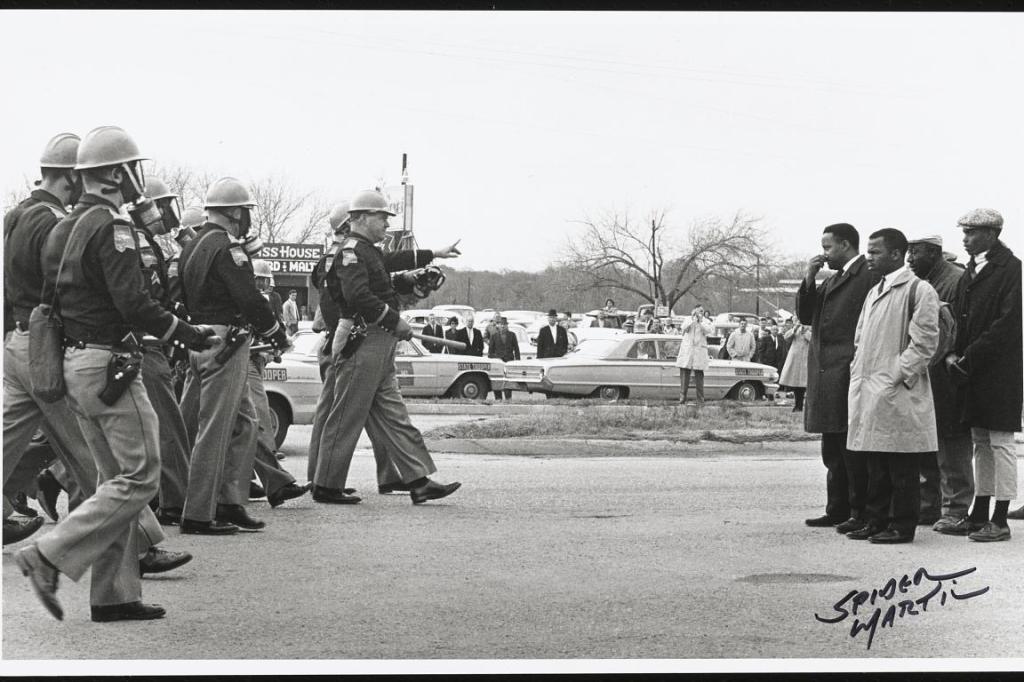
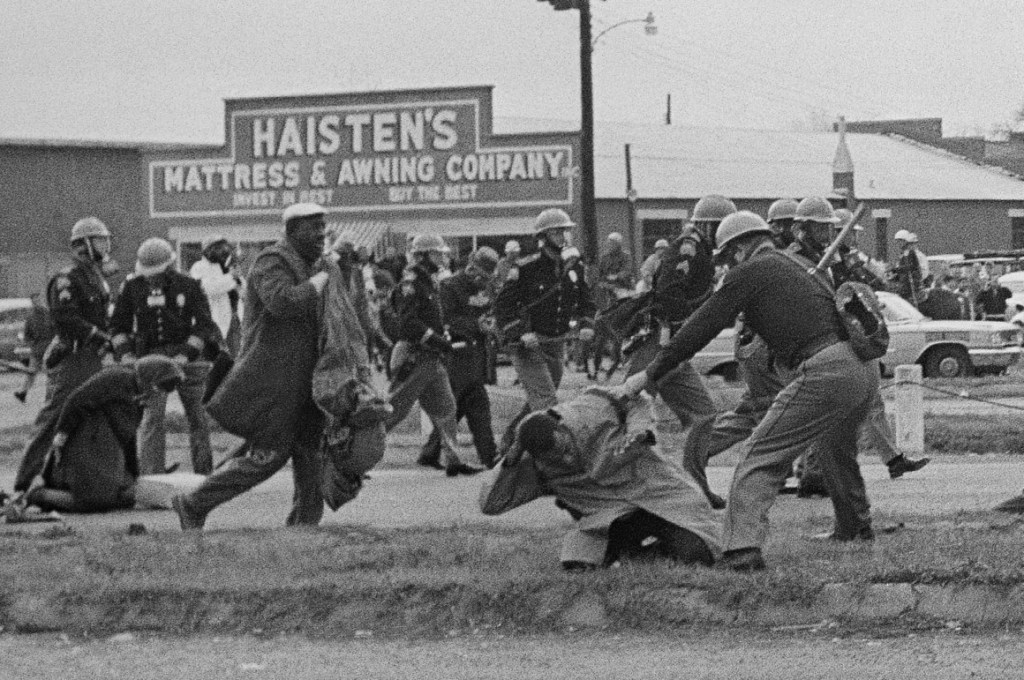
Police advance on protesters in Selma, Alabama on March 7, 1965
John Lewis (foreground) is beaten by a state trooper in Selma, Alabama, on March 7, 1965. The future congressman suffered a fractured skull.
Police advance on protesters in Lafayette Square on June 1, 2020 |AP

Today our country feels like it is ripping apart at the seams. Demonstrations against police brutality continue. This moment is reminiscent of the 1960s, with all its racial animosity, historic marches and police aggression against nonviolent demonstrations.

Today it’s as if Bull Connor and George Wallace have been brought back from the dead. Only this time, fire hoses and police dogs have been replaced by armored Humvees, low-flying Blackhawk helicopters, flash-bang grenades, rubber bullets, tasers, pepper balls and tear gas. Batons, shields and coordinated, aggressive police tactics remain unchanged.

A few weeks after the death of George Floyd, there are some signs that violence both on the part of the police and demonstrators is giving way toward a more peaceful and increasingly powerful demand to end racial injustice in America. It has been a long time in the making. Black Lives Matter, as a movement, has opened my eyes to how deep and pervasive racism has been and continues to be in this country. I knew things were bad, but I did not really grasp how difficult life is, every day, for people of color.

The American Civil War ended 155 years ago. The war was fought to settle the question of slavery (which is the most extreme form of racism) once and for all. After the war ended, it did not take long for white Americans to fight back – and fight back they did with devastating effect. Abraham Lincoln was assassinated by John Wilkes Booth on April 15, 1865. Vice President Andrew Johnson, a former slaveowner from Tennessee, ascended to the presidency. He did everything he could to turn back the clock. He was the first President to be impeached by Congress because of his efforts to impede racial justice in the South by removing President Lincoln’s Secretary of War. A description of his presidency seems like it could appear as an editorial opinion in the New York Times today:

For the most part, historians view Andrew Johnson as the worst possible person to have served as President at the end of the American Civil War. Because of his gross incompetence in federal office and his incredible miscalculation of the extent of public support for his policies, Johnson is judged as a great failure in making a satisfying and just peace. He is viewed to have been a rigid, dictatorial racist who was unable to compromise or to accept a political reality at odds with his own ideas…Most importantly, Johnson’s strong commitment to obstructing political and civil rights for blacks is principally responsible for the failure of Reconstruction to solve the race problem in the South and perhaps in America as well. Varon, Elizabeth R. “Andrew Johnson: Impact and Legacy”. Miller Center. University of Virginia.

Congress, led by the Republican party, fought back against Johnson. The Reconstruction Act of 1867, which was passed despite a veto by Johnson, gave newly enfranchised Blacks a voice in government for the first time in American history. They won election to southern state legislatures and even to Congress. Sadly, “in less than a decade, reactionary forces, including the Klu Klux Klan, would reverse the changes wrought by the Reconstruction Act in a violent backlash that restored white supremacy in the South.”

The Klan was formed by six Confederate veterans from Pulaski, Tennessee on Christmas Eve in 1865.  

Historians generally classify the KKK as part of the post-Civil War insurgent violence related not only to the high number of veterans in the population, but also to their effort to control the dramatically changed social situation by using extrajudicial means to restore white supremacy. In 1866, Mississippi Governor William L. Sharkey reported that disorder, lack of control, and lawlessness were widespread; in some states armed bands of Confederate soldiers roamed at will. The Klan used public violence against black people and their allies as intimidation. They burned houses and attacked and killed black people, leaving their bodies on the roads. Klu Klux Klan, Wikipedia.

Criminal prosecution of the Klan, led by President Ulysses S. Grant under the Enforcement Act of 1871, managed to suppress the Klan. Unfortunately, this was not the end of the line for the Klan. The release of the violent and disturbing motion picture, “Birth of a Nation” in 1915, sparked its revival. Members mimicked the movie, wearing terrifying, anonymous white robes with pointed hoods and riding on robed horses. President Woodrow Wilson, a native of Virginia, had a private screening of Birth of a Nation in the White House. After the screening, Wilson issued a public statement stating that he had been “unaware of the character of the play before it was presented and has at no time expressed his approbation of it. Its exhibition at the White House was a courtesy extended to an old acquaintance.” In private, Wilson is believed by most historians to have more accurately opined that Birth of a Nation was like “writing history with lightning.”

Woodrow Wilson’s record on race relations was not very good. African Americans welcomed his election in 1912, but they were worried too. During his first term in office, the House passed a law making racial intermarriage a felony in the District of Columbia. His new Postmaster General also ordered that his Washington offices be segregated, with the Treasury and Navy soon doing the same. Suddenly, photographs were required of all applicants for federal jobs. When pressed by black leaders, Wilson replied, “The purpose of these measures was to reduce the friction. It is as far as possible from being a movement against the Negroes. I sincerely believe it to be in their interest.” Woodrow Wilson and Race in America.

Over time, the Klan faded, but like a cancer in our land, it reemerged in the 1950s and 1960s during the civil rights movement and era of desegregation. The Klan forged alliances with Southern police departments, as in Birmingham, Alabama; and with governor’s offices, including the notorious George Wallace of Alabama. The Klu Klux Klan.

The history of the Klan shows that the notion of white supremacy has deep roots in American culture. It goes way beyond hate groups. The American legal system has enforced and even promoted white supremacy in subtle and not-so-subtle ways for centuries. After the Civil War, Black Codes were enacted, restricting the ability of freed slaves to work and in some cases perpetuating slavery for all practical purposes. These codes were eventually replaced by Jim Crow laws. Separate but equal treatment for Blacks (i.e., segregation) remained enforceable as the highest law of the land until it was overturned by the U.S. Supreme Court in 1954. When two Black students exercised their rights to register as students of the University of Alabama in 1963, President Kennedy federalized the Alabama National Guard to confront Governor George Wallace. Brigadier General Henry Graham of the Alabama National Guard approached with his troops. He first saluted Governor Wallace and then said, “Sir, it is my sad duty to ask you to step aside under the orders of the President of the United States.” After a few incredibly tense moments, Wallace stepped aside and Vivian Malone, together with James Hood, entered the University to complete their registration. In the days following the incident, the National Guard were ordered to remain on the campus owing to a large Klan contingent in the surrounding area. Stand in the Schoolhouse Door.

Sadly, despite its sordid history, the Klan has regained prominence, beginning in 2016 with the election of Donald Trump as President. During his campaign, Trump was endorsed by David Duke, the former Grand Wizard of the Klan, who proclaimed upon Trump’s victory in 2016: “This is one of the most exciting nights of my life -> make no mistake about it, our people have played a HUGE role in electing Trump! #MAGA.”

In August 2017, hundreds of far-right extremists descended on Charlottesville, Virginia, ostensibly to protest the removal of a Confederate statue from a local park. Dubbed “Unite the Right,” the gathering was the largest and most violent public assembly of white supremacists in decades. It evidenced a resurgent and emboldened white supremacist movement. ADL Blog. 600 white supremacists representing 39 states attended the event. In his controversial response to the violence in Charlottesville (which included a car speeding down a street filled with peaceful counter protestors, killing one and injuring 19), President Trump famously said that there were “very fine people on both sides” of the demonstration.

In the world of criminal justice, a pernicious and extremely effective form of white supremacy in the United States began to take shape in the 1970s. In 1971, President Nixon declared “drug abuse” to be public enemy number one. His “War on Drugs” largely remains on the books to this day. During its 49 years of reign, the War on Drugs has had a devastating effect on people of color. According to Nixon’s White House counsel, John Ehrlichman:

The Nixon campaign in 1968, and the Nixon White House after that, had two enemies: the antiwar left and black people. You understand what I’m saying? We knew we couldn’t make it illegal to be either against the war or Black, but by getting the public to associate the hippies with marijuana and blacks with heroin, and then criminalizing both heavily, we could disrupt those communities. We could arrest their leaders, raid their homes, break up their meetings, and vilify them night after night on the evening news. Did we know we were lying about the drugs? Of course we did. John Ehrlichman, to Dan Baum for Harper’s Magazine in 1994.

The War on Drugs escalated with the passage of the Sentencing Reform Act of 1984 and the Anti-Drug Abuse Act of 1986, which revised federal drug laws to carry very long maximum sentences – up to 40 years for some quantities, and up to life imprisonment for somewhat larger quantities. Suddenly, the amount of people incarcerated the United States surged. This surge continued in the 1990s, with no broken windows policing in New York under Mayor Rudy Giuliani, which eventually morphed into “stop and frisk” policing in New York under Mayor Michael Bloomberg. The collective effect of these laws and policing tactics over time has been mass incarceration, especially of Black Americans.

Despite making up close to 5% of the global population, the U.S. has nearly 25% of the world’s prison population. Since 1970, our incarcerated population has increased by 700% ­­– 2.3 million people in jail and prison today, far outpacing population growth and crime.

One out of every three Black boys born today can expect to go to prison in his lifetime, as can one of every six Latino boys—compared to one of every 17 white boys. ACLU “Mass Incarceration.

Wikimedia Commons

These statistics are appalling. And they make it easier to see how the system has been seemingly designed to keep black Americans from rising out of poverty, while at the same time instilling in them a rational fear of the police. Slavery was ended over 150 years ago, but the bondage of African Americans never really went away – it just evolved into a new form. 

Aggressive policing tactics and racism have accelerated under the combustible presidency of Donald Trump. In 2017, he told a crowd of police officers at a campaign rally “please don’t be too nice” when arresting people, encouraging them to deliberately not protect the heads of people being arrested and placed into the back of a police cruiser. Then things got even more extreme:

On January 11, 2018, during an Oval Office talk with several U.S. senators about protecting immigrants from Haiti, El Salvador, and African countries in a new immigration package, President Donald Trump unleashed a word that Americans aren’t accustomed to hearing from their president. “Why are we having all these people from shithole countries come here?” Trump reportedly asked. (He later denied having said this.) Months earlier, Trump had reportedly complained that Nigerian immigrants would never “go back to their huts” and Haitians “all have aids.” He doubled down at the Oval Office meeting. “Why do we need more Haitians?” Trump said. “Take them out.” In their stead, Trump spoke of taking in immigrants from great European countries like Norway, and also from Asian countries, since they could help America economically. The Day Shithole Entered the Presidential Lexicon.

More recently the President tweeted in response to Black Lives Matter demonstrations, “when the looting starts the shooting starts,” prompting a first-ever warning by Twitter, which stated that the Tweet, and an identical Tweet from the White House Twitter account, “violated the Twitter Rules about glorifying violence.”

It is against this backdrop racial animosity that the names Trayvon Martin, Tamir Rice, Michael Brown, Eric Garner, Philando Castile, Breonna Taylor, Ahmed Aubrey, and George Floyd, plus so many others, come into sharp focus. The history of our country is a history of persistent and pervasive racism on both an individual and collective level.

Vladimir Lenin said about history, “there are decades where nothing happens, and there are weeks where decades happen.” Could we be at a turning point?