Looking at the decibel-measuring app on my iPhone, I take a deep breath, and begin counting out loud: “1, 2, 3, 4, 5!” I take another breath, and continue: “6, 7, 8, 9, 10!” I look across the little desk at Paige for reassurance. She says, “That was awesome, Tim. I think some of them were over 90 db!”
Paige and Kaylee are my speech language pathologists. They are exhuberant and inspiring professionals. They spend a good part of each day helping children with various speech challenges and it shows. The TV in their cheery waiting room plays Netflix Kids. A little bunny named Gus Gus lives in their office. When I started therapy, I felt a bit self-conscious reading out loud and doing brain puzzles in the midst of a decidedly kid-friendly environment. Now I find it energizing.
We are quickly nearing the end of my 25 speech therapy sessions, and the results are in. My voice is noticeably stronger than it was before. I am encouraged and optimistic.
Learning to live with intent
People usually do not need to remind themselves to take a deep breath before talking, but I do! If I don’t remember to take a deep breath, I will run out of air as I near the end of a sentence. If I remember to breathe, my voice sounds as it should.
It turns out that there are two motor systems that allow each of us to talk, move around and function. The Pyramidal System allows us to learn new things, acting with intent. The Extrapyramidal System, on the other hand, allows us to do things automatically. Parkinson Disease is a disorder of the Extrapyramidal System. It impairs the automatic motor system through the loss of dopamine. The good news is that, even with PD, I can train myself to use the Pyramidal System to consciously bypass the automatic system and talk, do things, and live my life.
The universal can be found in the particular
There are some universal truths for everyone here. Who doesn’t want to live with more intention? The science checks out. By slowing down and acting with intent, we can break out of old habits and find new ways of doing things, resulting in more creativity. More positivity. Changing little things for the better. Getting out of old ruts and forging new pathways.
Sometimes, life can be extraordinarily simple. All we really need is a smile, some encouraging words and a deep breath. Then the possibilities are endless.
“Is the best protection hiding who you are, or being who you are?” – D.H. Lawrence.
In the past, talking with me about any serious topic could sometimes feel like talking to a wall. I would be looking right at you, but you might get the sense that nothing was really getting through to me. You would be right. In times of stress, I have a tendency to overwhelm and simply shut down.
For adult children co-dependents, the inability to communicate openly and honestly is clearly the result of a long adherence to the “no talk” rules. These dysfunctional and oppressive rules in combination form an iron curtain behind which the real self is hidden. As a consequence, the adult child develops a pseudo-self, a self that consists of a set of sophisticated maneuvers and strategies that are designed to ensure survival.[1]Subby, Robert C.. Lost In The Shuffle: The Co-Dependent Reality (pp. 66-67). Health Communications Inc. Kindle Edition.
Monument? What Monument?
When I was in high school, I visited the house of an acquaintance. After the visit, I got in my car and backed out of their driveway. It was cold and dark and the driveway was long. Suddenly, I heard a muffled crumpling sound. Going a little further, the headlights of my parents’ car revealed that I had backed over and completely destroyed a little brick monument marking the entrance to the driveway. I was too ashamed to get out of the car, knock on their front door and apologize.[2]As they say, the simplest solution is almost always the best solution. I wish I had known that at the time. I turned on the radio and drove away. I never apologized or even acknowledged that the incident had happened. The thought of admitting my mistake was unbearable. So I kept my mouth shut.
The no-talk rule eventually causes us to avoid our problems or deny that we have any problems. It fosters a feeling of impending doom, typified by knots in the stomach, free-floating anxiety, headaches and sleeplessness. We become emotionally numbed. Since we’re not supposed to talk about our problems, we don’t. We think that if we do admit to having a problem, then we are also admitting that something is horribly wrong with us that is not wrong with other people. If we admit to having a problem, then we open ourselves up to be judged by others as being weak or unhealthy. Ultimately, this denial of our basic situation fosters a deep sense of personal shame. Shame about things which otherwise should be viewed as very normal responses to living in a troubled family. We lose our perspective — namely, that people, all people, have problems.[3]Subby, Robert C.. Lost In The Shuffle: The Co-Dependent Reality (pp. 32-33). Health Communications Inc. Kindle Edition.
Don’t Talk or Over-react
Growing up, there were some exceptions to the no-talk rule in our house. The most common exception was our tendency to over-react in times of conflict. If anyone triggered our fragile egos, we would routinely have a hissy-fit, which was usually enough to shut everything down. It worked like a charm.
Over-reaction is a safe out because it indicates to others that in a sense you’re out of control, you’ve passed the point of no return, so they often retreat from the conflict. It’s safe because while you’re getting all caught up in your new reactive episode, you don’t have to be with yourself or the consequences. Under-reaction or passivity is safe because you can simply numb yourself to the conflict and by doing so manage to erect a facade of invulnerability and indifference that seems to say: “Nothing is bothering me.”[4]Subby, Robert C.. Lost In The Shuffle: The Co-Dependent Reality (p. 88). Health Communications Inc. Kindle Edition.
Everyone makes mistakes. Sometimes, we make big mistakes. No mistake is so bad, however, that it should be kept locked away in the dark. Indeed, we can choose to make friends with our mistakes, or at least not run away from them. After all, mistakes are the best teachers in life.
This afternoon, in my minds’ eye, I visited my friend’s house. I got out of the car, walked up to the front door, and rang the bell. A tall, familiar figure with kind eyes answered the door. I took a deep breath and said, “I’m really sorry, but I accidentally ran over the brick monument marking your driveway.” The figure smiled and offered me a hug, and I accepted.
Ingrid and Loren in 1985 at my sister Sheri’s wedding in Minnesota
“A deep sense of love and belonging is an irreducible need of all women, men and children. We are biologically, cognitively, physically and spiritually wired to love, to be loved.” – Brene Brown.
On November 13, 2021, in a brief graveside service, we laid an urn containing my mom’s ashes in the ground right next to my dad’s casket in Pine Lake Cemetery. After being apart for twenty-five years, Ingrid and Loren were finally together again.
Friends and family then gathered with us at Faith Covenant Church, where my mom and dad had attended for many years. We celebrated her life. We sang two hymns written by the beloved Swedish hymn writer, Lina Sandell. Jennifer and I did our best to make it through the Swedish verse. Tears of gratitude and relief effortlessly welled up from within all of us.
If you have read other posts in this blog, you know that the relationship I had with my mom was sometimes complicated. Remembering her with those who knew her best, I felt a simple and profound measure of peace and genuine joy for the many gifts that my mom brought into the world. Through the powerful words of remembrance by my mom’s closest friends, I could see my mom for who she was at her essence: a nurse, spouse, mom, sister, friend and survivor with an amazing sense of humor and an undeniable love for other people.
Healing does not happen in isolation. Human beings are social creatures. Even the most introverted of us need to feel like we belong. Feeling connected is essential to feeling loved. We need each other to complete the circle, remember what truly matters, and be happy.
“We shall not cease from exploration, and the end of all our exploring, will be to arrive where we started and know the place for the first time.” —T.S. Eliot
“Time is free, but it is priceless. You can’t own it, but you can use it. You can’t keep it, but you can spend it. Once you’ve lost it you can never get it back.” – Harvey Mackay
My mom died in the early hours of a recent October morning. Witnessing the death of a loved one in a nursing home is a heartbreaking experience. The artificial glow of fluorescent lights, the beeping of medical devices and the near constant noise produced by overworked staff and confused residents are uniquely dreadful. The experience could not more different than in the wilderness, where death to the suffering comes quickly and mercifully.
My mom’s mind and body failed gradually during the ten years she lived in the nursing home. Near the end, the gears of her life seemed to slip from forward into reverse. For weeks we brought vanilla and chocolate shakes, which she drank through a straw when we held it near her mouth. Eventually, my mom began refusing shakes. Then, she refused food and water. Her voice became very quiet and then nearly inaudible. She did not want to engage with us. She looked around her room and mumbled, “something evil is happening here.”
My mom had a major, disabling stroke at the age of 52 years. Six years later, she lost her main caregiver and champion, my dad. That was about 25 years ago. I can’t even begin to comprehend the suffering that my mom had to endure. I sat beside her bed near the end of her journey and watched her agitation and anxiety up close. I simply wanted the suffering to end. When she departed with my sisters and me at her side in the wee hours of the morning, the primary emotion I felt was relief.
In the quiet days with our family after Ingrid’s passing, Jennifer brought up from our basement dusty old boxes that had not seen the light of day for years. We carefully removed old family photographs from their yellowed, cellophane places stuck in old albums, scanning them one-by-one into the 21st century. Looking at old photos is a peculiar experience. It felt in some ways like I was looking into someone else’s life from a distant time and place. I recognize myself in many pictures much as an old friend would – missing some facts, but remembering exactly how I felt at each particular moment in my journey.
I cannot resist at this point giving the usual advice, which is simple and yet profound: enjoy the present moment and live life to the full! Life is precious. Time is racing and seems to be moving faster all of the time. Putting down my phone, I walk to our living room, crouch down by our sofa and gaze into the golden brown eyes of our beloved chocolate Labrador retriever, Freja. She is keeping her usual vigil, watching the street for strangers. I scratch her back. She rolls over. I rub her tummy and she sneezes, as she always does. This makes me smile. I kiss Freja on her nose and send out loving thoughts to my family and friends. I take deep breaths. In a few moments, I will be getting on my road bike for an afternoon tour with some friends on this beautiful, sunny autumn day. The leaves of the Norway maples in our neighborhood are bright yellow today. It will all be over in a flash. There is no time to waste.
Growing up in our house, my mom made a collection of cassette mix tapes and labeled them “Company Music.” These tapes were played whenever guests were visiting our home. They were recorded from various relaxing albums, like “Perhaps Love” by Placido Domingo and John Denver, and “You Don’t Bring me Flowers” by Neil Diamond. Company Music also included music by every evangelical band that came through town and performed a concert at our church. Our favorite was the Common Brothers Band, with its creepy hit, Revelation. Some of you have known me long enough to remember visiting our family in Livonia. Company Music was always played loudly enough to enjoy, but softly enough so that my mom could entertain our visitors while we feasted on supper time hot dishes like crescent rolls stuffed with tuna and cheese.
My mom was a formidable host. Company visiting our home were regaled by whimsical stories, many of which were exaggerated for effect. My now brother-in-law, Scott, went on a mission trip in high school. He also got his pilot’s license. Ingrid conflated these facts, and bragged to everyone that Sheri was dating a missionary pilot.
Christmas in our home was over the top. As soon as we finished eating the pumpkin pie for dessert on Thanksgiving Day, our family tore into numerous boxes labeled “X-mas,” which had been carefully pre-staged in the front hallway. For a few weeks, Christmas Music enthusiastically replaced Company Music. All season long Ingrid blasted holiday tunes from our stereo. We still groan when we hear Deck the Halls by Mannheim Steamroller, which we all love to hate.
There were many happy times in my home growing up. Happy times do not cancel bad times. They stand on their own – like opposing bookends in life. As for the icky stuff, as a kid, I didn’t really know that there was any other way to live.
Children are not co-dependent, they’re just needy and dependent. For little children, approval-seeking is a normal behavior. As children, we lack the ability to be independent. But as emancipated individuals, we have a choice and so to choose the co-dependent path is to choose freely. Only adults, then, can truly be co-dependent. They have a choice. Children are the victims in a troubled family, adults are volunteers.[1]Subby, Robert C.. Lost In The Shuffle: The Co-Dependent Reality (p. 25). Health Communications Inc. Kindle Edition.
I am 100% certain that my family relationships were co-dependent. But what does this really mean?
Co-dependency is a term that has been widely used within the chemical dependency field over the past several years. Originally, “co-dependency” was used to describe the person or persons whose lives were affected as a result of their being involved with someone who was alcoholic or chemically dependent. The “co-dependent” spouse or child or lover of someone who was chemically dependent was seen as having developed a dysfunctional pattern of coping with life, a constricted and often self-destructive pattern inexorably linked to someone else’s drug or alcohol abuse. The now familiar co-dependent strategies of minimizing, projection, intellectualizing or totally denying problems were seen as classic coping reactions to the chemically dependent person’s maladaptive behavior.
But now many professionals are coming to understand that co-dependency can emerge from any family system where certain overt (spoken) and covert (unspoken) rules exist — rules that interfere with the normal process of emotional, psychological, behavioral and spiritual development. Rules that close off and discourage healthy communication, rules that eventually destroy a person’s ability to form a trusting relationship within themselves or between others. Co-dependency is a pattern of living, coping and problem-solving created and maintained by a set of dysfunctional rules within the family or social system. These rules interfere with healthy growth and make constructive change very difficult, if not impossible.[2]Subby, Robert C.. Lost In The Shuffle: The Co-Dependent Reality (pp. 15-16). Health Communications Inc. Kindle Edition.
Over twenty years ago I practiced law at a big law firm based in Detroit. Our small group of international business lawyers included a former naval aviator, whom I will refer to in this post as Bob. He was a huge man with a combustible temper and a short fuse. He was demanding and quite impossible to please. A healthy person would have kept their distance. As they say, “the best armor is to stay out of range.”[3]Italian proverb.
As an ambitious young professional on an unhealthy quest to please everyone all of the time about everything, I was completely flummoxed by Bob. I tried in vain to jump through every hoop I could find to make him happy. No matter what I did, it was not good enough. In my family growing up, it was unacceptable for anyone to be upset, especially Ingrid. So when Bob was upset, I was also upset. I couldn’t handle any disapproval.
I asked my group leader what I could do to make Bob happy. In his wisdom, my group leader looked at me and said, “why are you so upset? You should be happy that Bob doesn’t want to work with you!” This is the co-dependent paradox. A co-dependent person cannot relax until everyone is happy, even if this means sacrificing their own needs in a quest for peace and a sense of normalcy that can never be found.
Until I began learning to have healthy relationships, life was often miserable. I spent enormous energy (and I still sometimes do) building my identity from the outside in, instead of from the inside out. I was highly reactive and oversensitive. Until I began the slow process of getting better, I simply acted out the co-dependent way of life that I learned as a kid.
See if you recognize any of these traits of co-dependence:
1. Difficulty in accurately identifying feelings: “Am I angry or sad or hurt or what?” “Am I truly depressed, or disappointed, or appropriately sad?” “Am I really frightened, or is my fear just an act?”
2. Difficulty in expressing feelings: “I feel angry, but it isn’t safe to let other people know.” “Anger is not okay.” “I feel depressed, really down, but I can’t talk with anyone — they wouldn’t understand . . . They might think that I was weak.”
3. Difficulty in forming or maintaining close or intimate relationships: “I want to be close to others but I’m afraid of being hurt or rejected.” “I’m not bright enough (good-looking enough, rich enough) to run with that crowd.”
4. Perfectionism — unrealistic expectations for self and others: “I never do anything right, I just screw up everything I do.” “If I can’t paint a perfect picture (write a poem, dance perfectly, and so on), then I just won’t do it at all.” “If he/she really loved me, they would have done it better.”
5. Rigidity in behavior and/or attitudes: “I’m too old to change.” “Even though I’m not happy with my life, I don’t know any other way, so why change.” “There’s only one right way to do things (like being a man, being a woman, raising a child, having sex, or getting to heaven), and that’s my way.” “It was good enough for my parents and it’s good enough for me.”
6. Difficulty in adjusting to change. “I’ll never forgive him for making me move away from our old house.” “He’s not really going to stay sober, so I’m not going to open myself up again.” “I don’t know why things have to keep changing anyway.”
7. Feeling overly responsible for other people’s behavior and feelings: “It’s my fault Sue killed herself. If only I had …” “I can’t leave her — she’ll never be able to handle it.” “I should apologize to my friends for what Frank said to them yesterday.”
8. Constant need for other’s approval in order to feel good about self: “Just tell me what you want from me and I’ll do it if it will make you happy.” “I’ll never be able to show my face around here again if I don’t get accepted to the university.” “Maybe if I become a doctor like my Dad he’ll be proud of me.”
9. Difficulty making decisions: “I can’t decide, I don’t want to make mistakes.” “When I have to make hard choices, my mind just freezes up and my brain feels numb and paralyzed.”
10. Feeling powerless, as if nothing I do makes any difference: “It’s a no win situation. No matter what I do, I lose.” “What’s the point in putting myself out, no one will remember.”
11. A basic sense of shame and low self-esteem: “When I make a mistake, it’s just another example of what a worthless person I really am.” “I come from a screwed up family, so there must be something wrong with me.”
12. Avoidance of conflict: “If I tell him how I feel, he might leave me.” “I have to act as if I agree, or they will get angry at me.”[4]Subby, Robert C.. Lost In The Shuffle: The Co-Dependent Reality (pp. 16-17). Health Communications Inc. Kindle Edition.
About ten years ago, with the love and support of my extraordinary family, I embarked on the path of recovery. One of the most important things I have learned is that feelings are neither good nor bad – they simply need to be acknowledged and experienced.
Now, instead of running from conflict and trying to escape pain using one futile device or another, I take a deliberate, deep breath and remain present in whatever experience life has to offer in this moment. This is a cause indeed worth celebrating. Fire up the Mannheim Steamroller!
“The opposite of spontaneity is depression. If this is true, then there must be one hell of a lot of depressed adult children co-dependents walking around out there. Worse yet, most of them probably don’t even know it. Who are these amiable-looking sleep-walkers? I call them the smiling depressed.”[1]Subby, Robert C.. Lost In The Shuffle: The Co-Dependent Reality (pp. 35-36). Health Communications Inc. Kindle Edition.
This morning, the humidity blanketed Freja and me during our early morning walk. Oh, how we both appreciated air conditioning when we got back inside! Freja lapped up a quick drink from her water bowl, jumped up on the couch, did her usual spin, plopped down, and fell fast asleep. Her muzzle reveals her age of eleven years, with its abundant white shoots nestled in her smiling brown chin. These days, Freja is mostly oblivious to the frequent arrival and departure of UPS or Amazon trucks. Age has brought us here. When she was a young pupper, she would never miss a potential threat on the street, much less on our front porch, where it seems every day one driver or another deposits a package from REI or Amazon.
Like Freja, I have been noticing that there is nothing really bothering me these days. Things are so different now. Growing up in my family was an uneasy experience. My dad’s part-time employment as a minister/counselor, combined with my mom’s work as a school nurse, somehow never seemed to cover all of our expenses. At the end of the month, we always seemed to come up short. Money was constantly on everbody’s mind, but we never talked openly about it. Instead, I witnessed our troubles first-hand in suffocating silence. Our crabby, chain-smoking optometrist, Dr. Leonard Spickler, wouldn’t budge when my mom tried to negotiate a post-dated check for soft contact lenses. He crossed his arms and said, “Mrs. Anderson, I am not a bank.” I felt like crawling under the nearest rock. My parents borrowed money from members of our church and relatives more than once, which was humiliating. Even though these burdens were not mine to bear, more than anything else, as a kid I wanted to please anyone and everyone. So I took on these burdens personally.
Being a member of a co-dependent family system meant that I was my family and my family was me. There were no boundaries and to me there was no difference. I was ashamed of my family, so I was ashamed of myself. I blamed my family, so I blamed myself. I didn’t like my family, so I didn’t like myself.[2]Subby, Robert C.. Lost In The Shuffle: The Co-Dependent Reality (p. 114). Health Communications Inc. Kindle Edition.
Going by outward appearances, everyone other than our family seemed to be prospering. Our ten-year old car was the only clunker in the church parking lot. I went over to my buddy’s house after church and noticed that his sock drawer would barely close — so many socks! In the meantime, my parents compensated for their worldly challenges by focusing on the successes of their children, especially their only begotten son – me. To show you what I mean, here is an excerpt from the church bulletin at Dearborn Covenant Church from 1979, where my dad served as one of the pastors:
More than anything else, I hated Sunday mornings. Before and after church, my mom would detail my accomplishments in front of everyone. I just stood there, trapped. My mom and dad were proud of me, which was natural. But there was something icky oozing below the surface with my mom. Her delight in me crossed an invisible, sacred line. I could feel her identity merging into mine. My successes became her successes. My accomplishments became her accomplishments. I despised the pressure of her impossible expectations. It felt like steam building in Chernobyl Reactor No. 4 right before it exploded.
In this country we have some dangerous myths about children. One of the most prevalent and destructive is the myth that children are resilient. What tripe! I have a difficult time believing that children are not damaged by the dysfunctional behaviors of their parents. Things like abandonment, neglect, rejection or other forms of abuse leave lasting scars. Animal studies have produced abundant evidence supporting the notion that physical touch, emotional comfort and other forms of parental nurturing are essential ingredients in the promotion of normal growth and development. These same ingredients are also essential for us humans.[3]Subby, Robert C.. Lost In The Shuffle: The Co-Dependent Reality (p. 60). Health Communications Inc. Kindle Edition.
My purpose in life seemed like it was to fulfill my mom’s needs. Statements of love from Ingrid were more accurately statements of her needs. I have thanked God many times for my first grade teacher, Mrs. Frances Baker. She somehow managed to imbue within me a level of self-acceptance. Ingrid’s confidence was all about her. I did not want to be paraded at church on Sundays like a show horse. All I wanted was for someone to look into my eyes, smile and give me a honey crisp apple to munch on in peace – without needing to jump over anything.[4]After publishing this post, a honey crisp apple in a brown bag addressed to “Tim” arrived mysteriously on our front porch. It was beautiful and delicious. I munched it in peace.
In a tactical move designed to protect myself from my mom, I learned in adolescence to stop sharing anything of relevance in my life with her. I was desperate to feel separate from her and experience an autonomous sense of self. I became pleasing and successful on the outside. On the inside, however, I felt an emptiness and rage that can only be understood by someone whose personal boundaries have been violated. Rather than learning to have genuine, loving relationships, I learned to use others for personal gain, mirroring the very dysfunction I learned from my mom, which she, too, learned somewhere along the line. More than anything, I wanted to be accepted. I was, however, terrified of being vulnerable, especially with myself.
You see, without a healthy, accepting and loving relationship within yourself, there is no room for self-actualization or a clear identity. For the practicing co-dependent there is only a kind of co-dependent pseudo-identity that is based on what you do, who you know, how much you make, where you live, or what religion you are. The co-dependent identity is an identity formed from the outside in, instead of from the inside out. As a result the individual becomes dependent on the outside realities in order to compensate for what is lacking on the inside. [5]Subby, Robert C.. Lost In The Shuffle: The Co-Dependent Reality (p. 65). Health Communications Inc. Kindle Edition.
In case you can identify any of this, it is never too late to begin or continue your journey of personal recovery. There is every reason to be optimistic. Here are some tips about how to recover from the icky, and get your life back:
1. Take one thing at a time. Recovery is a process that begins by starting where you are and by taking care of first things first. If you are an alcoholic, a bulimic, an anorexic, a workaholic, a gambling addict, an over eater, or a relationship addict, then start by getting help to take care of that issue first. Take time to end the addiction. Take time to get off your primary drug of choice. How long will it take? Perhaps one or two years, but remember: These will not be years spent in drudgery and self-denial, but they will be years filled with learning a new way of life, building healthy relationships and laying the foundation for self-actualization.
2. Remember that no one recovers alone from co-dependency. If you are isolated and have no support system, then you must take steps to seek one out. Find a counselor, a therapy group or a self-help program that can help you find your way out of dependency and co-dependency.
3. Stay with your new-found support system. Be consistent and tenacious about calling on them for help.
4. Focus on building trust in others’ ability to help you. Trusting relationships are essential to facing the many risks of change. Trust them and you will begin to trust in yourself.
5. Move at a pace that you feel comfortable with. This means you don’t have to do everything according to some ideal schedule of recovery. It means that you don’t have to do everything at once. This does not mean writing your own program, but simply means taking on only what you believe you can handle, given your resources. Your support system would be an excellent place to check out how realistic you are being about change. Recovery does not happen like a lightning bolt. Recovery is a process, and takes place in increments over time.
6. You have the right to say “No.” If it feels like the wrong thing to do, don’t do it. This is your recovery, not someone else’s. So when in doubt, check it out. Healthy systems of support will allow you the time and offer you the opportunity to prepare for change.
7. Put yourself first on the list of people to consider in the process of change. This does not give license to ignore the needs of others, but serves as a reminder to be, above all, considerate to yourself. Again, your support network will help you make decisions in a balanced and caring way. Let them help you explore the options.
8. Change often makes others react with hurt, fear, anger and resentment. You are part of a system and when you change, it puts strain on the system — others feel the stress. But remember that you are responsible to yourself first and others second. You can care about them without having to take care of them. Children may be the greatest challenge for you to face in this respect.
9. Take time to celebrate your successes, no matter how small.
10. Put more energy into loving yourself than you do in trying to love others. Learning how to love yourself is at the heart of learning how to love others in a healthy way.
11. Your feelings are okay — your reaction to them may not be. Learn to make this distinction. Healthy systems of support will validate your feelings and will offer you guidance on how to constructively deal with them.
12. No one recovers perfectly. Human beings sometimes make mistakes and fail. Healthy systems of support allow for mistakes.
13. Never take more than 50 percent of the responsibility in any relationship with other adults.
14. Try to avoid focusing on the problems of others and try to avoid solving their problems for them. Don’t waste time taking their inventories, mulling over their moral lapses and making tallies of their undesirable traits.
15. When you don’t know the answer to something, admit that you don’t know. When you want to know the answer, if there is one, ask someone who does know. And when you need help to do something, ask for it.
16. Don’t assume that others understand or care about what you want or need.
17. Remember to take time to rest and play.
18. Eat when you feel hungry, and sleep when you feel tired.
19. Share your feelings and problems in a safe place. Grieve your losses, but don’t grieve interminably — don’t become defined by your grief and dependent upon it. And be as understanding with yourself as you are with others.
20. Be true to yourself, above all, and remember wherever you go, there you will be.[6]Subby, Robert C.. Lost In The Shuffle: The Co-Dependent Reality (pp. 131-134). Health Communications Inc. Kindle Edition.
The trail of recovery has many twists and turns. The destination seems to get closer, but always feels a bit out of reach, much like climbing a mountain, one switchback at a time. This is perfectly normal.
I encourage you to reach out and share your journey with safe people in your life. Company is essential on the trail.
After publishing this post, a honey crisp apple in a brown bag addressed to “Tim” arrived mysteriously on our front porch. It was beautiful and delicious. I munched it in peace.
“The only journey is the journey within.” – Rainer Maria Rilke
I could write an entire book about my mom, Ingrid, and her impact on my life. She was born in the late 1930s in Chicago to Swedish immigrant parents. She lived with undiagnosed bipolar disorder until she was 40 years old. She slept poorly for most of her life.[1]In this post, I often refer to my mom in the past tense. She is still with us, living with dementia in a nursing home in Michigan, not far from our home. Much of her is already gone, so it … Continue reading At her best she was hilarious, charming and intelligent. At her worst she was volatile, narcissistic and manipulative. For as long as I can remember, I simultaneously loved, feared, and distrusted her.
Early on in the theater of life, she passed out scripts for my dad, my sisters and me. We all played our assigned roles under her expert curation. Step out of line, and she would give you the evil eye. Challenge her and you could quickly find yourself on her bad list.[2]For people with borderline personality disorder, things are often perceived us in black and white. “Signs and symptoms of borderline personality disorder may include:
An intense fear of … Continue reading My dad played out his role as a kindly powder keg, and my mom constantly reminded everyone of his anger and anxiety, which she alone could provoke into an enormous mushroom cloud, devastating everything in its path. It scared the hell out of all of us. There was a mix of dread and anxiety in our home, interlaced with nervous laughter and more than a few happy days.
Ingrid’s Special Gift to the World
Here is the script I got from my mom early in my childhood:
You will be a doctor or a lawyer, even though you suck at math just like me. You will make piles of money, which will be used to take care of me in my old age. You will discover a cure for cancer, perfect the unified field theory of physics, win the Nobel Peace Prize, and be elected president of the United States in landslide elections for two consecutive terms. While pursuing these things, you will perform flawlessly without making any mistakes. If you do make a mistake, you will not tell anybody that you made it, because everything you do reflects directly on my achievements as your mother. You are me, and I am you. Now, even though I am a minister’s wife with young children at home, I am moving to Ann Arbor to study pediatric nursing at the University of Michigan. I will be home on most weekends, but during the week you are on your own. I made some hot chocolate powder that you can heat up and enjoy after school. Have fun!
My mother’s emotional and physical absence during my early elementary school years and beyond made it challenging for me to navigate the world. My dad spent long hours in the church office, trying to please one congregation or another. He was, as they say, unavailable, though I knew he was a kind-hearted man with only good intentions for everyone, including me. I competed with my dad for my mom’s affection. In her eyes, I could do no wrong – that is, until I did manage to cross her, which happened on rare occasion. Then there was hell to pay.
When my parents were around, they consciously embraced a “hands off” parenting style, which involved letting us make our own decisions in all matters of life, great or small. You can imagine how stressful this is for kids. They need functioning adults to show them how to do things. Kids do not yet have the tools to navigate life successfully on their own. And they need to learn, all along the way, how to have appropriate boundaries and respect for others, neither of which I learned until much later in life.
Turn Up the Radio
To further complicate matters, conflicts in my family were never resolved. They were simply brushed under the rug. If an argument developed during a car ride, my mom would turn on the radio to WJOY FM. We would all listen to relaxing elevator music until whatever was bothering us drifted by and could be safely ignored. We carried on in this manner until the next crisis emerged and was quickly handled accordingly – or more accurately, not handled at all.
I emerged from my childhood with an enormous chip on my shoulder. I was pissed off, plus I had an insatiable ego and lots to prove according to my assigned script. Underneath the surface, I was brittle, lonely and terribly insecure. I tried constantly to figure out what would please my mother and did my best to meet her impossible expectations without missing the mark. To make matters even worse, whenever my will conflicted with hers, she always got her way. This made me even angrier. For example, I liked to part my hair down the middle and feather the sides, which was all the rage in the early 80s. She liked bangs, so I kept my hair accordingly all throughout my college years. In the seventh grade I wanted to learn the French horn and brought one home after school. It sounded sweet! She made me return it the next day to the school and stick with my old, beaten-up trumpet. “You are a trumpet player, and that’s that.” Ironically, in college I obsessed about becoming a trumpet player in a large, professional orchestra. She, on the other hand, insisted that I was going to become a lawyer, which would make her so proud. I relented under the force of her personality.[3]In some ways, especially things having to do with money, I am happy that I became a lawyer. I learned lots of interesting things, worked on some amazing deals and interacted with international … Continue reading
Winning the Lottery
In contrast to my early years, the best thing that ever happened to me was marrying Jennifer. Getting married is like rolling the dice. You can never be certain that the person you are marrying will grow and mature over the years in ways that are mutually compatible. Call it God’s grace or dumb luck, we somehow managed to roll double sixes.
In Western cultures, more than 90 percent of people marry by age 50. Healthy marriages are good for couples’ mental and physical health. They are also good for children; growing up in a happy home protects children from mental, physical, educational and social problems. However, about 40 to 50 percent of married couples in the United States divorce. The divorce rate for subsequent marriages is even higher.[4]https://www.apa.org/topics/divorce-child-custody
Our marriage has been far from perfect. Despite some enormous ups and downs, our marriage has survived and is now thriving. For this I am super grateful. I grew up in a home where the nominal tension of life was so thick that it could be cut with a knife. The vibe at home today with Jennifer and our girls is totally different. When I pull into our driveway, my blood pressure goes down. I am happy to be here.
The Parking Lot Incident
The turning point in my life with Ingrid came in the early 90s. Jennifer and I signed up for therapy and took a course on Boundaries, which was life-changing for both of us. I cannot recommend the book more: “Boundaries: When to Say Yes, How to Say No To Take Control of Your Life” by Dr. Henry Cloud and Dr. John Townsend.
I will never forget the first time I applied good boundaries with my mom. It was Sunday morning, and I drove to Southfield to pick up my mom for church. Jennifer was home with Annika, a toddler. Annika was fighting a low-grade fever. I pulled up in front of my mom’s assisted living facility. I loaded my mom carefully into the passenger seat of our Ford Taurus. After getting on the road, I told her about the situation. Nurse Ingrid suddenly appeared and suggested that we administer a low dose of Motrin for little Annika. I said, “Jennifer and I have decided to let the fever be, and let her body figure things out on its own.” Ingrid was not pleased with this answer and insisted that we give Annika the medicine. Ingrid refused to budge.
According to Winston Churchill, a fanatic is someone “who can’t change their mind, and won’t change the subject.” On this Sunday morning, I kept trying to change the subject, but my mom wouldn’t relent. I decided to try out one of the lessons I was learning in therapy about Boundaries. I said, “mom, if you do not drop this thing about the Motrin, I am going to turn around this car and bring you back to “the place” (my mom’s preferred name for the Heatherwood, her assisted living home, which she hated intensely). After we had driven a few more miles in silence, Ingrid said, “I still think you should give Annika the Motrin,” and I lost it. Wheeling around our Ford in a way that would make a Michigan State Trooper proud, we were on our way back to the place, this time speeding more than a few miles over the posted speed limit. We pulled into the parking lot in front of the Heatherwood, I got out of the car abruptly, walked around to the passenger door, opened it, and ordered my mom to get out. She refused. In a manner that would have warranted a 911 call by a concerned bystander, I reached in and tugged, doing my best to extricate Ingrid from our Ford. “Oow! Oow! Stop!” she protested. After a few seconds, I realized that her seatbelt was still fastened, which was why she wouldn’t budge. Holding my breath, I reached across her body and unbuckled my mom’s seatbelt. Still she refused to get out. She said to me, “get back in the car. We are going to church!” I then resorted to lying. “Mom, I just need you to get out for a minute so that I can reposition you to be more comfortable in the car.” This confused her and somehow worked. She got out of the car, I placed her cane in her left hand, ran around the front of the car as fast as I could, hopped into the driver’s seat and sped away from my mom with the passenger door still open. She could not believe what was happening. I stopped the car when I was at a safe distance, reached across the passenger compartment, somehow managed to pull the passenger door shut, and then zoomed out of the parking lot. Looking back in the rearview mirror, Ingrid just stood there, in disbelief. I got on the highway. Eventually, after some deep breaths, my heart slowed back to normal.
It has been many years since the parking lot incident, which was not my proudest moment. Jennifer and I have each grown older and wiser. Ingrid has grown older and, sadly, has continued her long cognitive and physical decline.
I have forgiven my mom and have found a way to love her genuinely and with compassion, which is a gift for both of us. Now we don’t have much to say – and that is ok. She just smiles, looks into my eyes. I look into her eyes. She says: “I am so happy that you are my boy. You look so much like dad.” I sit on the side of her bed and hold her hand. At long last, we have made our peace.
“If we start being honest about our pain, our anger, and our shortcomings instead of pretending they don’t exist, then maybe we’ll leave the world a better place than we found it.” – Russell Wilson
In this post, I often refer to my mom in the past tense. She is still with us, living with dementia in a nursing home in Michigan, not far from our home. Much of her is already gone, so it doesn’t feel wrong to refer to her in the past tense.
For people with borderline personality disorder, things are often perceived us in black and white. “Signs and symptoms of borderline personality disorder may include:
An intense fear of abandonment, even going to extreme measures to avoid real or imagined separation or rejection
A pattern of unstable intense relationships, such as idealizing someone one moment and then suddenly believing the person doesn’t care enough or is cruel
Rapid changes in self-identity and self-image that include shifting goals and values, and seeing yourself as bad or as if you don’t exist at all
Periods of stress-related paranoia and loss of contact with reality, lasting from a few minutes to a few hours
Impulsive and risky behavior, such as gambling, reckless driving, unsafe sex, spending sprees, binge eating or drug abuse, or sabotaging success by suddenly quitting a good job or ending a positive relationship
Suicidal threats or behavior or self-injury, often in response to fear of separation or rejection
Wide mood swings lasting from a few hours to a few days, which can include intense happiness, irritability, shame or anxiety
Ongoing feelings of emptiness
Inappropriate, intense anger, such as frequently losing your temper, being sarcastic or bitter, or having physical fights”
In some ways, especially things having to do with money, I am happy that I became a lawyer. I learned lots of interesting things, worked on some amazing deals and interacted with international people, which was fun and rewarding. Still, living life by the billable hour in a large law firm is a recipe for unhappiness.
“What is the cost of lies? It’s not that we’ll mistake them for the truth. The real danger is that if we hear enough lies, then we no longer recognize the truth at all.” – Valery Legasov (HBO mini-series “Chernobyl”)
The biggest threat facing America today is not climate change, inflation, or rising authoritarianism. The biggest problem is the spread of misinformation. Its consequences are profound. Trust – a prerequisite for any group living together – is obliterated. Empathy – the capacity to understand or feel what another person is experiencing from within their frame of reference – is destroyed. The carrier of our disease is misinformation. No one is immune – not in the largest city, nor in the smallest town.
Commercializing Mistrust and Contempt
The algorithms used by Facebook, Google, Amazon, Apple, and other big tech companies, are turbocharging the spread of misinformation, resulting in a profound lack of connection in our country. These algorithms, buried deep within applications we use everyday, are driving advertising revenue at a record pace. They are also isolating us and filling our minds with information that is popular – and verifiably false.
Here is how it works in the case of Facebook:
The Facebook Artificial Intelligence powered algorithm is designed to suck users into the content that interests them the most. The technology is tuned to serve up more and more of what you click on, be that yoga, camping, Manchester United, or K-pop. That sounds great, right?
Facebook’s methods for capturing our attention are unique:
Many people talk about partisan news outlets as a major problem driving Americans apart. Yes, the ideological focus of MSNBC is different from FOX and The New York Times leans in a different direction from The Wall Street Journal. However, there is a massive difference between choosing to get your news from a cable TV network or a newspaper vs. having the news appear on your Facebook feed. The element of choice is removed with Facebook because the news comes to you based on what you clicked on in the past rather than what you choose to click on now. This becomes a huge problem for those who are curious enough to dip their toes into a conspiracy theory. Facebook traps people.
Imagine you “like” a story sent by a dear friend about how the Apollo lunar landings were faked, perhaps not even reading the story. Later, you get another link from Facebook on the theme of faked moon landings and it makes you wonder… Maybe you then search Facebook for more stories about the Apollo missions being faked because you are curious. You’re in! Facebook has now trapped you. You will get more and more content based on what you are beginning to (falsely) believe to be true.
Each one of us is predisposed to believing things that are untrue. All decisions made by human beings suffer from some level of bias and noise. Bias is how we tend to look at a problem based upon our cultural background and personal experience.
In a set of groundbreaking studies in 1932, psychologist Frederic Bartlett told volunteers a Native American legend about a young man who hears war cries and, pursuing them, enters a dreamlike battle that eventually leads to his real death. Bartlett asked the volunteers, who were non-Native, to recall the rather confusing story at increasing intervals, from minutes to years later. He found that as time passed, the rememberers tended to distort the tale’s culturally unfamiliar parts such that they were either lost to memory or transformed into more familiar things. We now know that our minds do this all the time: they adjust our understanding of new information so that it fits in with what we already know. One consequence of this so-called confirmation bias is that people often seek out, recall and understand information that best confirms what they already believe.
This tendency is extremely difficult to correct. Experiments consistently show that even when people encounter balanced information containing views from differing perspectives, they tend to find supporting evidence for what they already believe. And when people with divergent beliefs about emotionally charged issues such as climate change are shown the same information on these topics, they become even more committed to their original positions.[3]https://www.scientificamerican.com/article/information-overload-helps-fake-news-spread-and-social-media-knows-it/
In addition to fighting bias, we need to be aware that our decisions are affected by noise:
Bad weather is associated with improved memory; judicial sentences tend to be more severe when it is hot outside; and stock market performance is affected by sunshine.[4]Kahneman, Daniel; Sibony, Olivier; Sunstein, Cass R. Noise (p. 87). Little, Brown and Company. Kindle Edition.
A study of nearly seven hundred thousand primary care visits. . . showed that physicians are significantly more likely to prescribe opioids at the end of a long day. Surely, there is no reason why a patient with a 4 pm appointment should be in greater pain than one who shows up at 9 am. Nor should the fact that the doctor is running behind schedule influence prescription decisions. And indeed, prescriptions of other pain treatments, such as nonsteroidal anti-inflammatory drugs and referrals to physical therapy, do not display similar patterns. When physicians are under time pressure, they are apparently more inclined to choose a quick-fix solution, despite its serious downsides. Other studies showed that, toward the end of the day, physicians are more likely to prescribe antibiotics and less likely to prescribe flu shots.[5]Kahneman, Daniel; Sibony, Olivier; Sunstein, Cass R. Noise (p. 87). Little, Brown and Company. Kindle Edition.
What steps can we take to improve our process for making decisions in our quest to cut through bias and noise and find the truth?
1. Consider the Source
Just because you see something popular on TV, or read about it in Facebook, or Twitter, doesn’t mean it is true. When deciding whom and what to believe, consider the credentials of the journalists involved and the organizations they represent. Science over conspiracy. Facts over lies. Truth over hyperbole.
2. Act like a Judge
A wise friend of mine said to me the other evening, “how can I make a decision about this after only hearing one side of the matter?” Like a courtroom judge, we owe it to our community to hear each side present its case without interruption before making any conclusions, no matter how tempting it may be to retreat to our usual defensive (or offensive!) positions. This is not easy. Hearing from the other side requires meeting and talking with people who do not share your particular viewpoint. It will be uncomfortable, but it also is the only way to find potential areas of mutual understanding.
3. Walk in their Shoes
Use your imagination to see what it would feel like to walk in someone else’s shoes. A failure of empathy leads to extremism in all of its forms. The truth of the matter is that we are all just human beings, trying to do our best. It is human nature to reciprocate gestures of kindness. Even if a kind gesture is rejected, it is always the right thing to do.
4. Turn their Flank
Centuries of military history have proven that a direct assault against an opponent’s strongpoint will be costly. Most likely, it will also fail. An indirect approach is much easier, and more likely to succeed. The best strategies inevitably involve the least possible use of force. Approach a difficult subject from a different angle. Make your opponent comfortable. Move. Be flexible.
5. Don’t go there
It saddens me to scroll through the news and social media and see so many personal attacks on public figures, especially attacks based upon personal appearance or assumed level of intelligence. Personal attacks are tempting to make. They are also cheap, unfair and inhumane. They don’t belong in our public conversations, nor do they belong in our private conversations. They also make compromise almost impossible to reach.
“People will forget what you said, people will forget what you did, but people will never forget how you made them feel.” – Maya Angelou
In 1982, I got my first job as a bus boy at the Big Boy restaurant in the Livonia Mall. I rode my ten-speed bicycle back and forth to our house, listening on a Sony Walkman knock-off FM Radio to the latest hits on WLLZ[1]https://en.wikipedia.org/wiki/Billboard_Year-End_Hot_100_singles_of_1982. The hourly minimum wage in 1982, which for some reason I can still remember clearly, was $3.35 per hour.
As a 16-year-old on a ten-speed, riding home in the dark after washing dishes at Big Boy, I could not possibly fathom that, 39 years later, I would sometimes ride this route in the afternoon for fun. It’s an easy ride to the Hearthstone subdivision, where I lived beginning in the 6th grade. Much of this route has been repaved in asphalt – a road biker’s dream in Michigan, which has a well-deserved national reputation for bumpy roads.
Memories Flow into Gratitude
Every time I ride in my old neighborhood, without fail, the memories come flooding back. I feel as if I am back in 1982. At first, the painful memories arrive. Happily, these are always chased by an abundance of positive memories, bubbling up to the surface. All of these memories and feelings have now surrounded my heart, leaving me with a simple and profound feeling of gratitude for my life and for the people I have met along the way, many whose names and faces I can barely recall.
More than anything I feel connected with the past as I roll slowly past my old house at 19941 Brentwood, Botsford Elementary School, Clarenceville Junior High School and Clarenceville High School. I think about the jobs I had at the Livonia Mall during my high school years, working at Big Boy, the Shoe Department at Crowley’s and then the Men’s Furnishings Department, where I folded dress shirts and arranged them carefully on display with colorful ties. I also remember driving on Saturday mornings to Livonia Youth Symphony rehearsal. I can recall trumpet Lessons with Mr. Manguth and Mr. Moots as if they happened yesterday. I also very much remember and appreciate the four summers I spent working at Portage Lake Bible Camp in high school and then in college. I am grateful for all of it.
My Evolving Faith
Many things have changed in my life since those formative years, including my faith. I have lifted off the large backpack of evangelical dogma that I had been carrying around for years. As soon as this backpack was resting safely on the ground, I felt a huge sense of relief. There were things that I was unable to carry any further on the trail, including the belief that the Bible is the only “perfect” rule for faith, doctrine, and conduct.
Perhaps this will explain my convictions on this further:
Though the defenders of Biblical inerrancy are adamant that God has spoken, they grow nervous when it’s suggested God continues to speak. They become frightened when someone implies God might say something different from their closely guarded interpretations of Scripture. I once shared this need to protect the Bible. Now I realize that suggesting God continues to speak doesn’t lessen the value of the Bible but instead reclaims one of its central tenets. God speaks fresh words. I believe God spoke to the men and women of the Bible. I believe God has always spoken to his children, perhaps in an audible voice, but far more often through gentle prompting, circumstance, or other people. But I don’t believe we’ve always gotten the message straight. This is the reason God continues to speak. He doesn’t ask us to rely solely on the testimony of others. He doesn’t wish to be known by rumor or reputation alone. The God who spoke to Peter is equally committed to speaking to you and me. The Bible was never intended to end the conversation, but to encourage it. God didn’t fall silent with the last chapter of Revelation. He continues to reveal himself. It makes no sense to glorify the accounts of our ancestors’ encounters with God while dismissing our experiences with him today.[2]Gulley, Philip; Mulholland, James. If Grace Is True: Why God Will Save Every Person (pp. 37-38). HarperCollins. Kindle Edition.
Also, I cannot now find a way to reconcile the “Good News” of the gospel that I accepted as a child with the proposition of Hell, which is an indispensable part of the evangelical message as it is mostly preached today across America:
Nowhere is such spiritual split-mindedness more evident than in our statements about human destiny. On the one hand, we assert God is loving and merciful. On the other hand, we believe God will forever torture the very people most in need of forgiveness. We seldom question the jarring contrasts of such beliefs, preferring to live with the inconsistencies rather than be transformed by God’s grace.[3]Gulley, Philip; Mulholland, James. If Grace Is True: Why God Will Save Every Person (pp. 66-67). HarperCollins. Kindle Edition.
The consequences of this thinking are very destructive:
Unfortunately, salvation as recruitment continues to drive most religion. The crusades of this age have been in large stadiums rather than battlefields, but the motive remains the same. We remain confident of our salvation and the damnation of others. This sin is characteristic of nearly every religious group. It motivates Mormons to knock on the doors of church parsonages, inspires Christians to send missionaries to Israel, and even justifies Muslims flying airplanes into skyscrapers. Instead of asking ourselves why there are gentle, humble, gracious people in every religious tradition, we seek to recruit or destroy them. We are uncomfortable with the thought that God might be at work in all the world, in all people, and even in all religious systems. Sadly, I’ve discovered that traditional Christianity, Islam, and Judaism share one common belief—they are certain God won’t save everyone. Those who knocked on my door or handed me a tract on the street suspected I wasn’t saved. In recent years, when I’ve confessed that I believe everyone will be saved, I’ve confirmed their suspicions. They thought my belief in the salvation of everyone a sure sign of damnation. [4]Gulley, Philip; Mulholland, James. If Grace Is True: Why God Will Save Every Person (pp. 159-160). HarperCollins. Kindle Edition.
My Beliefs Today
I believe there is a God and that each of us is very much loved by God. Beyond this, I have lots of questions and very few answers. And that’s fine with me – maybe even a good thing.
I have other sheep that are not of this sheep pen. I must bring them also. They too will listen to my voice, and there shall be one flock and one shepherd. – John 10:16
O-sha-gus-co-day-way-quay (Woman of the Green Glade) was the daughter of Waub-o-jeeg (the White Fisher), a highly regarded Ojibwe war chief living in Chequamegon Bay on Wisconsin’s north shore. O-sha-gus-co-day-way-quay was skilled at hunting and fishing. She was also was incredibly strong. In her retirement years, she would spend time alone in the woods each spring making maple sugar, sometimes returning with as much as two tons.[1]Parker, Robert Dale, ed. (2007). The Sound the Stars Making Rushing Through the Sky: The Writings of Jane Johnston Schoolcraft. Philadelphia: University of Pennsylvania Press. pp. 7–17.
In 1791, John Johnston, a fur trader originally from northern Ireland, befriended Waub-o-jeeg’s clan of the Ojibwe people in his travels on Lake Superior’s southern shore seeking trading partners. O-sha-gus-co-day-way-quay caught his attention immediately. Wasting no time, Johnston asked Waub-o-jeeg for his daughter’s hand in marriage. Waub-o-jeeg was reluctant, fearing that Johnston would abandon her, which white men had done to other young Ojibwe brides married in the pursuit of trading aliances.
The chief answered that he had been cheated by the French and the English alike and that he did not trust any white man. Johnston explained that he was neither French nor English, he was Irish, and that he always tried to be an honorable man. Waub-o-jeeg told him to go away for one full year. At the end of that time, if he was still interested, he should return and ask again.[2]Rydholm, C. Fred (1989). Superior Heartland, a Backwoods History (Vol. I), p. 91.
Johnston did as Waub-o-jeeg had instructed him. He returned one year later.
“Chief Waub-o-jeeg,” said the young man, “I have returned, as I promised.”
“Sit down,” motioned the Chief. “Let us smoke. Here I have some fresh kiniknick.”
“White Man, I remember my promise. I do not want my daughter left with children and no husband to provide deer meat for them. Now I ask a promise from you. . . . That you will marry her as the White Man marries a white woman – until your death!”
“I promise, good father,” Johnston said seriously. Then, each man smoked Waub-o-jeeg’s red bowled pipe to seal the promise, after which Johnston untied the cord binding the pack which was beside him, on the sand. He removed a long barreled gun, a carrot of tobacco, a bag of balls and one of powder, a woolen blanket, and glass beads, and laid them all before that chief.
“A brave of your nation would bring you a deer or beaver skins as a present to mark this occasion. I’ve only trade goods to offer you, Chief Waub-o-jeeg. Please accept my poor gifts,” said the trader.
“Your gifts will never take the place of my daughter, White Man,” returned the stately father, “but I accept them as a promise that you will stay married into your death, and as a pledge that you will always care for her and your children.” [3]Virginia Soetebier (2000). Woman of the Green Glade p. 22.
O-sha-gus-co-day-way-quay did not participate in the conversation between her father and the Irishman, nor is there any record that her opinion about the proposed marriage was ever sought. Waub-o-jeeg’s second wife simply informed O-sha-gus-co-day-way-quay to go and bathe quickly and get dressed in her best white beaded deerskin dress and leggings. O-sha-gus-co-day-way-quay did as she was told. A lively party broke out in camp. She was mortified when she learned the reason for the celebration. She was getting married that very day to Johnston!
Later in the evening, after the festivities died down, she was carried into a canoe by her father, uncles and brothers and they paddled to nearby Madeline island, where Johnston had constructed a little wooden cabin for himself the year before. Soon, the canoes all returned to the mainland. Johnston and O-sha-gus-co-day-way-quay found themselves alone with each other in the little dark cabin. O-sha-gus-co-day-way-quay was furious that her father had given her to a white man in marriage. She was also greatly afraid of Johnston. She sat motionless all night in a corner of the cabin. Johnston covered her with a blanket and then walked across the room to his bed, and eventually went to sleep. For the next ten days she ate no food. She drank water only when Johnston was outside of the cabin. She did not speak to Johnston the entire time. After ten days of this silent standoff, Johnston left the cabin to hunt and take a break.
In Johnston’s absence, O-sha-gus-co-day-way-quay took the opportunity to run. She returned to the forest near her village with the help of some young boys fishing nearby who had a canoe. She eventually returned to her village. She was relieved to find that her father was not home.
When he did return, he was furious that she had run away from Johnston and beat her with a stick. When he was finished he shouted: “Now I shall return you to your rightful husband. If you run away again, I will cut off one of your ears, and if you run away a second time, I will cut off the other one!”
Waub-o-jeeg returned O-sha-gus-co-day-way-quay by canoe to the island, and then led her to Johnston’s cabin. He then announced, “here is my daughter. She has disgraced our family and our nation by her behavior. Take these gifts; let them make up to you for what you have endured on her account. She will never leave you again. I Waub-o-jeeg, give you my word!” Johnston gently replied, “I was greatly saddened by her absence. I welcome her back. Come, let us smoke together.” [4]O-sha-gus-co-day-way-quay entered the cabin meekly and attended to her hearth for the first time. Virginia Soetebier (2000). Woman of the Green Glade pp. 36-37.
O-sha-gus-co-day-way-quay and John Johnston resettled to Sault Ste. Marie (also known as the “Soo”), which was the hub of fur trading in the Great Lakes region. His business prospered. Over time, O-sha-gus-co-day-way-quay used her maiden name less and less. She married Johnston in a civil ceremony, was baptized and took the name Susan. Her children simply called her Neengay, my mother.[5]Virginia Soetebier (2000). Woman of the Green Glade p. 68. By all accounts O-sha-gus-co-day-way-quay and Johnston grew to love each other, despite the rough start to their marriage.
Johnston was a “wintering partner” of the North West Company; one of the men who traded directly with the trappers, who were usually of Native American descent. He was a man of substance, having arrived in Canada with capital to invest in the business. He and his wife were influential in the trade and relations among the Ojibwe, Canadians, Europeans and Americans in the area. They received as hosts many explorers, politicians of both Canada and the U.S., scholars, Native chiefs, and military officers. They were considered among the ruling class in both the Native and European communities. Johnston owed much of his success to Ozhaguscodwaywayquay’s talents, influence, and connections as the member of an important Ojibwe family. Ozhaguscodaywayquay taught him and their eight children the language and ways of the Ojibwe. While she learned to understand English, she only spoke Ojibwe. John taught them to speak, read, and write English, and had a large library from which some of the children particularly drew.[6]https://en.wikipedia.org/wiki/Ozhaguscodaywayquay
In 1818, Lewis Cass was appointed governor of the territory of Michigan, which included Michigan, as we know it today, plus all of Wisconsin and part of Minnesota. He proposed a government expedition to survey the region, which he would personally lead: “all told, the expedition consisted of 40 men traveling in 3 large birchbark canoes, 35 feet long and 6 feet wide, each capable of a cargo of 4 tons. Leaving Detroit amid much fanfare on May 24, 1820, they took just over two weeks to reach Mackinac Island, where they remained a week to gather in additional supplies.
Next, they headed for Sault Ste. Marie to meet with some Chippewa (Ojibwe) chiefs. From Fort Mackinac they picked up two more canoes and twenty-two soldiers provided by the Commandant of the garrison for the Governor’s protection. This brought the expedition to the full complement of forty. The second day out of Fort Mackinac, the flotilla passed the ruins of the British fort on St. Joseph’s Island, which the American troops had burned in 1814 at the end of the 1812 War.” [7]Rydholm, C. Fred (1989). Superior Heartland, a Backwoods History (Vol. I), pp. 95-96.
The British fort at St. Joseph was the fort from which the British launched their first offensive of the War of 1812.[8]See https://realifematters.com/2021/04/25/first-people/ Johnston served as a Captain in the British Army. He helped lead the attack on Mackinac Island.
At the Soo, they met the family of John Johnston. Johnston himself was not home but his wife Susan was – she was the most influential person in the area – and she and her son George were very hospitable. They brought the party to a camping spot near a Ojibway village of some 200 or 300 men, women and children. George Johnston introduced Cass to the Chiefs.” [9]Rydholm, C. Fred (1989). Superior Heartland, a Backwoods History (Vol. I), pp. 95-96.
From this point, things quickly took an ugly turn.
Governor Cass asked the Indian leaders for a piece of land on which to construct a fort that would secure the border between the United States and Canada. This made the Indians very solemn, as they had fought beside the British in the war of 1812 and were still loyal to their former allies.
After a day of discussing the question among themselves, one of the Chiefs, named Sasseba, who had been nicknamed “The Count,” appeared in a full British officer’s uniform and spoke angrily to the governor. He thrust his spear into the ground, kicked aside the presents which had been presented to him, and stalked from the tent, followed by the others. Later, Captain Douglass saw Sasseba raise a British flag in front of his lodge. He notified Cass, who ordered his soldiers to arms.
Taking his interpreter with them, Cass marched into the Indian village, through a group which had assembled. He tore down the flag and trampled it underfoot. Through his interpreter he told the Indians that this was American soil and only the American flag could fly here. If the British flag was raised again, the Indians would be destroyed. Cass’s audacity caught the Indians so off guard that none made a move to stop him as he carried the British flag back to his tent.
The Indians held a council of war that went on into the night. Hostility rose, but when it seemed as though a battle could not be averted, O-sha-gus-co-day-way-quay came to the council fire. She told the chiefs not to take sides in the rivalries of white nations. To do so would only bring suffering and vengeance upon their own people. She said that they should negotiate a treaty that would benefit the Indians and that everyone could live with.
This could have been a serious incident, as Cass’s party was greatly outnumbered, but the Indians had great respect for Susan Johnston and they listened to her and agreed. They drew up and signed a treaty that ceded a tract of land on which Fort Brady was built 2 years later. In the treaty, as in most of the treaties of the Lakes Indians, it was specified among other things that they be allowed to fish the rapids forever.” [10]Rydholm, C. Fred (1989). Superior Heartland, a Backwoods History (Vol. I), pp. 95-96.
Making Peace
Finding a peaceful resolution to disputes is difficult. Once the “flight or fight” response has been triggered, the urge to be right can be irresistable.
O-sha-gus-co-day-way-quay’s intervention in 1820 at the Soo between Cass and his soldiers, and Sasseba and his warriors, shows that the way of peace takes great courage and inner strength. Defying the odds against her, O-sha-gus-co-day-way-quay, an Ojibwe woman, negotiated a peaceful resolution to this conflict.
In the movie Dances with Wolves, Kicking Bird says in the Lakota language to John Dunbar, “I was just thinking that of all the trails in this life, there are some that matter most. It is the trail of a true human being. I think you are on this trail, and it is good to see.” [11]https://en.wikipedia.org/wiki/Dances_with_Wolves A human being’s highest purpose is to love. Given a chance, love can win.
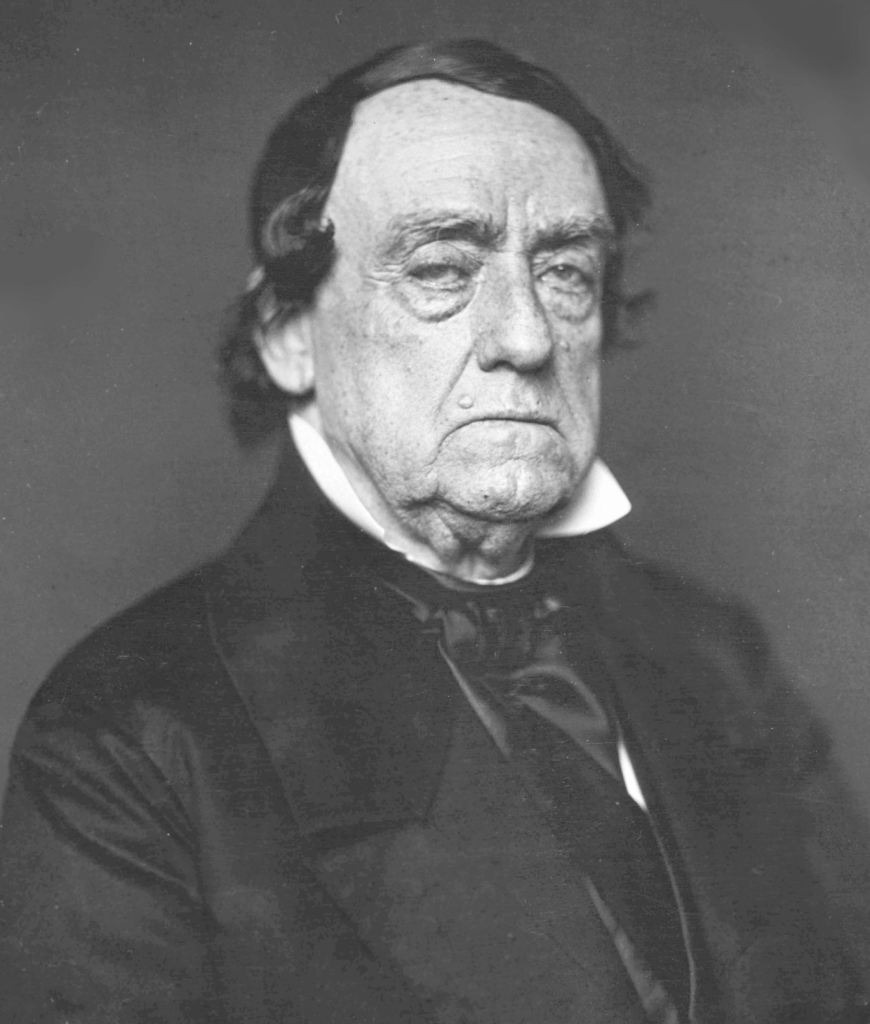
Lewis Cass
Trail of Tears
Ten years after the incident at the Soo, Governor Lewis Cass resigned as Governor of Michigan to accept President Andrew Jackson’s appointment as Secretary of War. In this capacity, he helped implement Jackson’s policy of Indian removal. Removing the Native Americans was Jackson’s top legislative priority.
Jackson’s 1830 State of the Union address provides a glimpse into his mindset toward the Native Americans:
What good man would prefer a country covered with forests and ranged by a few thousand savages to our extensive Republic, studded with cities, towns, and prosperous farms, embellished with all the improvements which art can devise or industry execute, occupied by more than 12,000,000 happy people, and filled with all the blessings of liberty, civilization, and religion?[12]https://en.wikipedia.org/wiki/1830_State_of_the_Union_Address
The Indian Removal Act of 1830 was signed by Jackson after a vote on razor-thin margins in the House and Senate. It was enforced under his administration and that of Martin Van Buren for eleven brutal years. After the passage of the Indian Removal Act, approximately 100,000 members of the Cherokee, Muscogee (Creek), Seminole, Chickasaw, and Choctaw nations were forcibly removed from their ancestral homelands, with thousands dying along the Trail of Tears. This period was among the saddest and darkest in American history.
Note the contempt expressed by President Andrew Jackson regarding Native Americans. He doesn’t acknowledge their unique culture and traditions, instead referring to them publicly as “Savages.” To Jackson, the Native Americans were an annoying impediment to the drumbeat of American progress.
America 2021
The situation in America today is really no different. Indeed, those who do not learn from their mistakes are destined to repeat them.
America is addicted to political contempt. While most of us hate what it is doing to our country and worry about how contempt coarsens our culture over the long term, many of us still compulsively consume the ideological equivalent of meth from elected officials, academics, entertainers, and some of the news media. Millions actively indulge their habit by participating in the cycle of contempt in the way they treat others, especially on social media. We wish our national debates were nutritious and substantive, but we have an insatiable craving for insults to the other side. As much as we know we should ignore the nasty columnist, turn off the TV loudmouth, and stop checking our Twitter feeds, we indulge our guilty urge to listen as our biases are confirmed that the other guys are not just wrong, but stupid and evil.[13]Brooks, Arthur C.. Love Your Enemies (pp. 28-29). Broadside e-books. Kindle Edition.
The challenge most of us are facing is how to give up our addiction to contempt. The answer is both obvious and perplexing:
Addicts all want to be free from addiction, and there is a lot of help out there to set them free. All they have to do is let go of the thing they hate, and ask for what they truly want. But they don’t, sometimes even until death. Why not? Most say the short-term agony of quitting is just too great, or that booze or other drugs, as terrible as they are, are the only thing that give real satisfaction in an empty life. We have a cultural addiction to contempt—an addiction abetted by the outrage industrial complex for profit and power—and it’s tearing us apart. Most of us don’t want that, though. We want love, kindness, and respect. But we have to ask for it, choose it. It’s hard; we are prideful, and contempt can give a sense of short-term purpose and satisfaction, like one more drink. No one ever said that breaking an addiction was easy. But make no mistake . . . we can choose what we truly want, as individuals and as a nation.[14]Brooks, Arthur C.. Love Your Enemies (pp. 38-39). Broadside e-books. Kindle Edition.
I admit that I am quick to reach for the bottle of contempt in my life. The broken part of me loves to scroll through Twitter, drinking from the well of self-righteousness.
Will I learn anything from the folks on the receiving end of my indignation? Only one thing is certain. If I don’t set aside my feelings, and open my heart, I cannot and will not be moved.
“There comes a time when we must stop crying and wringing our hands and get on with the healing that we are so much in need of.” – Art Solomon, Anishinabe Elder
Parker, Robert Dale, ed. (2007). The Sound the Stars Making Rushing Through the Sky: The Writings of Jane Johnston Schoolcraft. Philadelphia: University of Pennsylvania Press. pp. 7–17.
O-sha-gus-co-day-way-quay entered the cabin meekly and attended to her hearth for the first time. Virginia Soetebier (2000). Woman of the Green Glade pp. 36-37.