

“Oh, the history books tell it, they tell it so well
The cavalries charged, the Indians fell
The cavalries charged, the Indians died
Oh, the country was young, with God on its side”
– Bob Dylan
It has taken a while to finish this post. Starting it was easy. I gravitated immediately to Bob Dylan song, but then I hit a wall. I set out to write something meaningful about the poignant history of the Anishnabe (First People) in Michigan. As it turns out, writing about history is not easy. History leads you down one curious rabbit hole after another. Plus, it is inherently challenging for a 21st-century mind to understand anything about anyone who lived in the 17th, 18th or 19th centuries. It is hard enough to imagine life before the Internet, much less life before electricity, plumbing or running water. But there are lessons here worth learning. How we treated one another in the past gives us unique insight into how we should treat people today who we encounter who are different than us.
The story about the First People in upper Michigan is nuanced. A lot happened after the Europeans arrived in 1659. Territory changed hands in a blur of dates until 1815, when England and America entered into the Treaty of Ghent, ending the War of 1812. Even more happened between the War of 1812 and January 6, 2021, which marked the first time since August 24, 1814, that a hostile force took over the U.S. Capitol. This time, insurgents punched their ways through glass and doors, defecating and urinating on federal property, and marching a Confederate flag through the U.S. Capitol building.
I sometimes wonder what life in North America would be like had Europeans and the Americans not shown up in force and taken over the place. The First People got overshadowed by overwhelming economic and political forces. It is like the scene in Dances with Wolves, where Kicking Bird asks John Dunbar about the number of white people that will eventually come to the Prairie: “How many?” Dunbar motions to the heavens and says, “Like the stars. . . .” [1]https://en.wikipedia.org/wiki/Dances_with_Wolves
With its woodland upper and lower peninsulas, Michigan would scarcely be recognizable today if Europeans had not migrated here. Imagine arriving in Detroit from an overnight flight from Europe, walking through customs, and showing your passport to an Alongquin Nation customs and border protection officer for admission for 90 days as a visitor for business or pleasure. Contrary to popular myth, the First People did not vanish. They are still here. In most cases, however, they do not hold the keys to power in America, which makes it challenging to see them and hear what they have to say to us – and they have a lot to say.
They call themselves and all Indians the Anishnabe (First People). At first they were the “Otchipwe” as written by Bishop Frederick Baraga. The French pronounced it “Ojibway” and the English called it “Chippewa.” The two names are used today and sometimes the Central Ojibwe are called the Chippewa, but they are all the same people. They make up the nucleus of the Algonquin Nation. This huge nation was made up of many tribes and, though some have drifted far from the main groups, they can still be recognized by their language origin. Besides the Ottawa, Chippewa, and Potawatomi there are the Fox, the Sac, the Saulk, Menominee, Pocumtue, Narragoset, Munsee, Massachusett, Massauaketon, Pennocook, Penobscot, Mohican, Delaware, Shawnee, Miami (or Omaumeg), Kickapoo, Sutia, Cheyenne and Arapaho, Salteaux, Ok-ewein, and, yes, the Sanguinay (whom the whites called the Beaver), as well as many others.
The Algonquin tribes occupied the region around the Great Lakes and practically all of the drainage area into these waters. North of them were the Cree (also of Algonquin origin), west of them were the Sioux, south of them were a group of tribes collectively called the Illinois, and east of them were the Iroquois, made up of such tribes as the Seneca, Cayuga, Oneida, Mohawk, Onandagas, and, after 1712, Tuscaroras – a league known as the Six Nations. For hundreds of years, the greatest enemies of the Algonquin People were the Iroquois and the Sioux. The warring, if any, was all east and west, seldom if ever north and south. [2]Rydholm, C. Fred (1989). Superior Heartland, a Backwoods History (Vol. I), pp. 28-29.
The French fur trappers and Jesuit priests were the first Europeans to arrive in what is now known as the upper peninsula of Michigan in the mid-1600s. The trappers were on the hunt for otter, marten, mink, and especially beaver pelts for trade back to Europe, which could not get enough of them to make hats. The Jesuits, on the other hand, were in search of souls to be converted to Christianity.
The First People were a peaceful, woodland people. When required, however, they defended their territory when the Sioux attacked from the west, and when the Iroquois attacked from the east. History also forced the First People to cope with ever-increasing numbers of Europeans and Americans filling the shores of the Great Lakes. The Europeans brought with them concepts about land ownership that were foreign to them. Europeans also brought new technology, especially guns. A long gun could keep an entire village in the upper peninsula from starving by ensuring a reliable supply of venison all winter long.
The French and the British also brought to North America their relentless obsession for dominion over one another. The First People got caught up in these struggles. They formed fleeting alliances as the situation unfolded from their own perspective. From 1754 until 1763, the First People and the French fought against the British and their allies, the Iroquois people, in the so-called French and Indian War. In 1763, at the conclusion of this war, England was victorious the British expelled the French from most of North America. King George III proclaimed that all of the lands west of the Appalachian Mountains and east of the Mississippi River belonged to Native Americans.
Thus, at least for a few years, it looked like the First People would finally be able to hold onto a relatively large portion of their traditional territory, including all of what we now know as the territory of the State of Michigan, all the way south to the Gulf of Mexico.
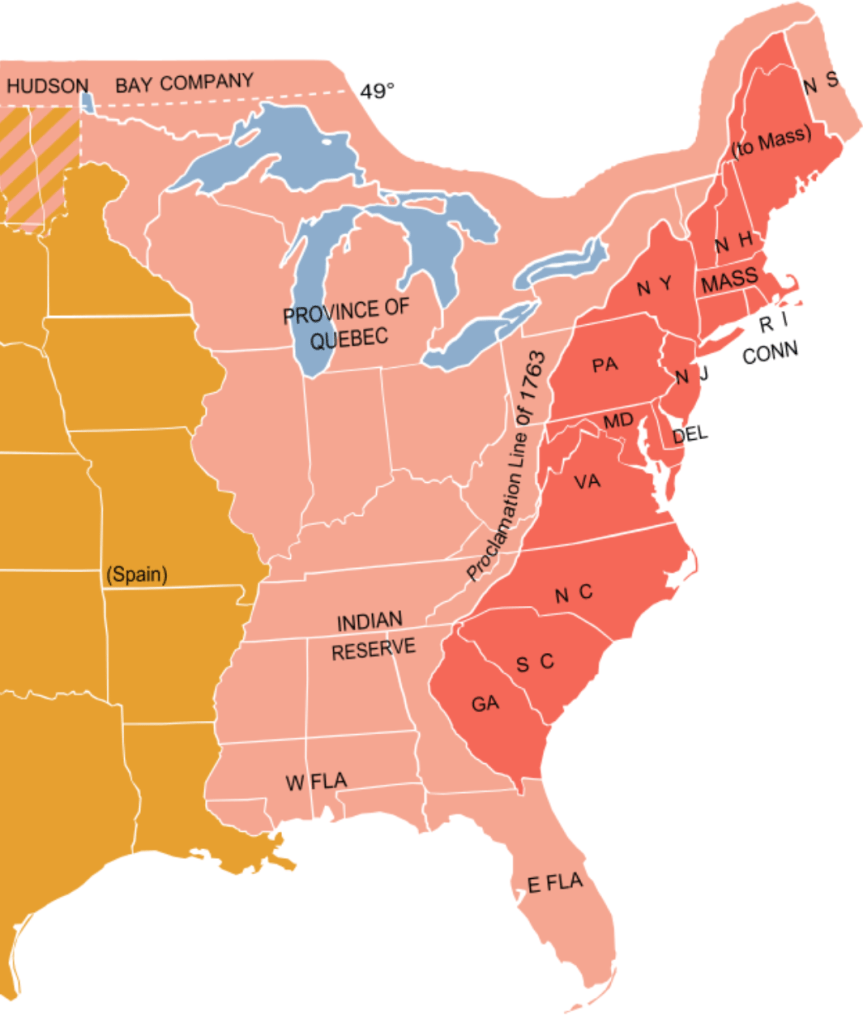
But it would not last. King George had to impose taxes on the colonies to repay the massive debt the Crown incurred to cover the cost of its wars in Europe and North America. Local Americans resented this taxation, along with other encroachments, like the quartering of troops in private homes. You already know what came next: the American Revolutionary War. At its conclusion, America won possession of all of the former British colonies along the eastern seaboard along with the Great Lakes. Everything was set forth meticulously in the Treaty of Paris (1783).
This was a difficult blow to the First People. Gone now was the huge territory in the Ohio Valley reserved for the Anishnabe and various other tribes of Native Americans. The French had left. The British had mostly left. Now the Anishnabe were forced to deal with the Americans.

Having a treaty signed and ratified is one thing. Enforcing it is an entirely different matter. The British refused to evacuate their forts in the Great Lakes for years after the Revolutionary War, arguing, probably correctly, that the Americans had not fulfilled all of their obligations under the Treaty of Paris.
President George Washington eventually dispatched Supreme Court Chief Justice John Jay to England to negotiate with the British an end to these lingering disputes. England and the United States entered into the Jay Treaty in 1794. In this treaty, the British agreed to vacate Fort Miami, Fort Detroit and Fort Mackinac in the Great Lakes. Historian Marshall Smelser argues that the Jay treaty effectively postponed war with Britain, or at least postponed it until the United States was strong enough to handle it. [3]https://en.wikipedia.org/wiki/Jay_Treaty
The British finally vacated the fort on Mackinac Island in 1796. They would not, however, be gone for very long.
First Battle of Mackinac Island (1812)
In June 1812, at the very beginning of the War of 1812, British Major-General Isaac Brock sent a canoe party 1,200 miles to confirm that a state of war existed between England and America. Believe it or not, this was a brilliant and expeditious way to communicate this important news. The canoe party returned quickly with an order to attack Fort Mackinac. In contrast, the American Secretary of War sent word to the Great Lakes by ordinary post, and it did not reach Mackinac Island in time.
A minimal United States garrison of approximately sixty men under the command of Lieutenant Porter Hanks then manned Fort Mackinac. Although a diligent officer, Hanks had received no communication from his superiors for months.
On the morning of July 17, 1812, a combined British and Native American force of seventy war canoes and ten bateaux under the command of British Captain Charles Roberts attacked Fort Mackinac. Captain Roberts came from Fort St. Joseph and landed on the north end of Mackinac Island, 2 miles (3.2 km) from the fort. The British removed the village inhabitants from their homes and trained their two 6-pounder iron cannons at the fort. The Americans, under Lieutenant Hanks, were taken by surprise and Hanks perceived his garrison was badly outnumbered. The officers and men under Roberts numbered about two hundred (including 180 Canadians); a few hundred Native Americans of various tribes supported him.
Fearing that the Native Americans on the British side would massacre his men and allies, Lieutenant Hanks accepted the British offer of surrender without a fight. The British paroled the American forces, essentially allowing them to go free after swearing to not take up arms in the war again. They made the island inhabitants swear an oath of allegiance as subjects of the United Kingdom.
Shortly after the British captured the fort, two American vessels arrived from Fort Dearborn (Chicago), unaware of the start of the War of 1812, or the fort’s capture by British forces. The British raised the American flag and when the vessels tied up at the pier, the British captured the two slops as prizes of war. The ships were Erie (Captain Norton) and Friends Good Will (Captain Lee), the latter being taken by the British into service as HMS Little Belt. The schooners Mary and Salina, anchored at port, were sent by the British to Detroit as cartels carrying the prisoners they had taken.
After capturing the island, the British under the command of Colonel Robert McDouall of the Royal Newfoundland Regiment built Fort George, a stockade and blockhouse on the highest point of the island, to prevent the Americans from re-capturing the island using the same strategy. Lieutenant Hanks made his way to Detroit and the American military post there. Upon his arrival, superiors charged him with cowardice in the surrender of Fort Mackinac. Before the court martial of Lieutenant Hanks could begin, British forces attacked Fort Detroit. A British cannonball ripped through the room where Hanks was standing, cutting him in half and killing the officer next to him as well. [4]https://en.wikipedia.org/wiki/Fort_Mackinac
This spooked Hanks’s commander, Brigadier General William Hull, who had been drinking and was a nervous wreck. He surrendered Fort Detroit to the British later that day. He gave up his post after an elaborate ruse by the British and their Native American allies, which led him to believe wrongly that there were several thousand Native Americans preparing to massacre everyone in the Fort. Hull was later court martialed and sentenced to death for his cowardice in surrendering Fort Detroit, though his sentenced was commuted by President Madison.[5]https://www.history.com/this-day-in-history/detroit-surrenders-without-a-fight
Second Battle of Mackinac Island (1814)
Two years later, the Americans returned to Mackinac Island to recapture the fort there. Almost everything went wrong for the Americans.
On July 26, 1814, a squadron of five United States ships arrived off Mackinac Island, carrying a landing force of 700 soldiers under the command of Colonel Croghan. This landing began the Battle of Mackinac Island. To his dismay, Colonel Croghan discovered that the new British blockhouse stood too high for the naval guns to reach, forcing an unprotected assault on the wall of Fort George. The Americans shelled Fort George for two days with most shells falling harmlessly in vegetable gardens around the fort.
A dense fog forced the Americans back from Mackinac Island for a week. Major Andrew Holmes led the American forces in returning; they landed at the north end of the island near the location of the British assault in 1812. The Americans worked their way to the fort through dense woods, which Native American allies of the British protected, finally emerging into a clearing below Fort George.
Colonel McDouall had placed a small force bearing muskets, rifles, and two field guns behind low breastworks at the opposite end of the clearing. When the Americans emerged from the woods into the clearing, the British guns targeted them easily. British forces killed 13 Americans, including Major Holmes and two other officers, and wounded 51 others. The heavy losses compelled Colonel Croghan to order his men to retreat back through the woods to the beach. The Americans rowed back to their ships and retreated.
The American defeat in the Battle of Mackinac Island left the island and its forts in the hands of the British through the end of the War of 1812. Following the Treaty of Ghent, American forces reoccupied Fort Mackinac in July 1815. [6]https://en.wikipedia.org/wiki/Fort_Mackinac
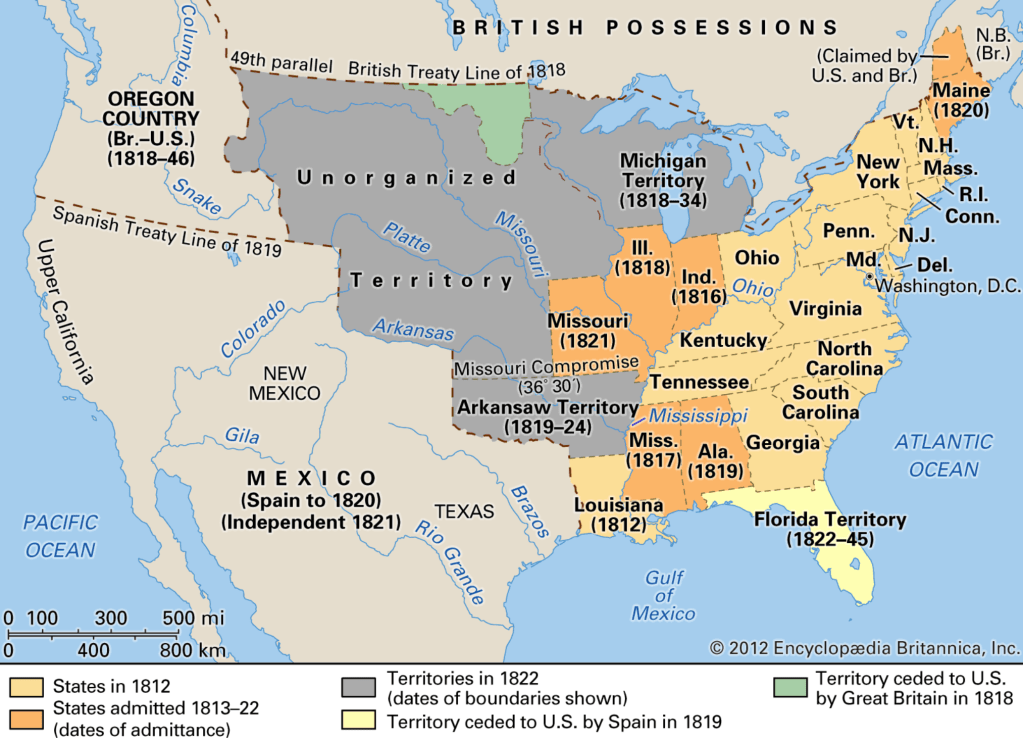
After the War of 1812, a map of the United States looked like this:
Why does any of this matter today?
History shows us that when given a choice to exert control over groups of people who are different or treat them with dignity and respect, the usual path is to exert control over them. Americans are most likely to “shoot first, and ask questions later.” When encountering conflict, history begs us to slow down. An old lawyer said to me once, “Act in Haste. Repent at Leisure.” Our individual and collective egos propel us into “fight or flight mode,” making quick and emotional decisions without thinking things through. A decision made quickly on a complex matter more often than not leads to unnecessary suffering.
How America has treated the First People and other non-White people matters. At a minimum, white Americans must acknowledge the collective sins of our past without qualification. As a society, we can no longer gloss over it all and pretend that we are color blind. It is easy to shrug our shoulders and say, “what happened in the past belongs in the past. Leave it there.” But the past really isn’t ever totally in the past. The consequences of the past are still with us today in the form of discrimination and an uneven playing field among Americans. We have a moral responsibility to face this reality.
“Grandfather, Look at our brokenness. We know that in all creation only the human family has strayed from the sacred way. We know that we are the ones who are divided and we are the ones who must come back together to walk in the sacred way. Grandfather, Sacred One, Teach us love, compassion and honour that we may heal the Earth and each other.” – Art Solomon, Anishinabe Elder
In the next post, I will pick up the story, when the Americans square off against a band of Ojibwe a few years after the War of 1812, and O-sha-gus-co-day-way-quay, daughter of Waub-o-jeeg, chief of the Ojibwe band of Chequamegon Bay on Wisconsin’s north shore, intervenes and narrowly averts violence between the Ojibwe and the Americans at Sault St. Marie in Michigan’s upper peninsula.
References
| ↑1 | https://en.wikipedia.org/wiki/Dances_with_Wolves |
|---|---|
| ↑2 | Rydholm, C. Fred (1989). Superior Heartland, a Backwoods History (Vol. I), pp. 28-29. |
| ↑3 | https://en.wikipedia.org/wiki/Jay_Treaty |
| ↑4, ↑6 | https://en.wikipedia.org/wiki/Fort_Mackinac |
| ↑5 | https://www.history.com/this-day-in-history/detroit-surrenders-without-a-fight |