“Our refusal to acknowledge grief and death has twisted us into a culture riddled with death. One of Jung’s more chilling observations was that whatever we put into the shadow doesn’t sit there passively waiting to be reclaimed and redeemed; it regresses and becomes more primitive.”[1]Weller, Francis. The Wild Edge of Sorrow: Rituals of Renewal and the Sacred Work of Grief. (Function). Kindle Edition.
I follow a prescribed daily regimen of vocalizing to strengthen my voice, which is increasingly affected by my Parkinson disease.[2]I used to deal only with hypophonia, which is a decrease in the volume of my speech. Now I am also dealing with dysarthria, which for me involves the slowing of my speech, some unexpected pauses and … Continue reading I also play the trumpet and my guitar and sing – anything to keep my vocal cords active and moving. This strategy seems to be helping. On days I vocalize, my voice is noticeably louder. This always makes me happy and relieved.
Not being able to express myself through speaking is unnerving! It does, however, have its benefits. No one would ever say that I talk too much!
I find it curious that the grief over losing my voice dissipates almost immediately after I simply acknowledge this loss. I say quietly to my grief: “Welcome. Make yourself comfortable. You can stay as long as you like.”
By the same token, whenever I take steps to avoid grief, I almost always end up making things worse – allowing the situation to be even more painful and distressing.
People always seem to have something to say, but it is also interesting to notice what people are not saying. Many of us are walking through life carrying unmetabolized grief.[3]Francis Weller writes about the importance of metabolizing grief, and this resonates with me. Sometimes grief hides in plain sight as anger, bitterness, and resentment. These are cover emotions, concealing the genuine grief and hurt stuck just under the surface.
By leaning into grief – saying yes and welcoming it into the daylight – I actually bring myself into closer alignment with the universe and my truest self. I witness both the beauty and loss within and around me with a full, open heart.
“Anything that’s human is mentionable, and anything that is mentionable can be more manageable. When we can talk about our feelings, they become less overwhelming, less upsetting, and less scary. The people we trust with that important talk can help us know that we are not alone.” – Fred Rogers
I used to deal only with hypophonia, which is a decrease in the volume of my speech. Now I am also dealing with dysarthria, which for me involves the slowing of my speech, some unexpected pauses and the slurring of some of my words.
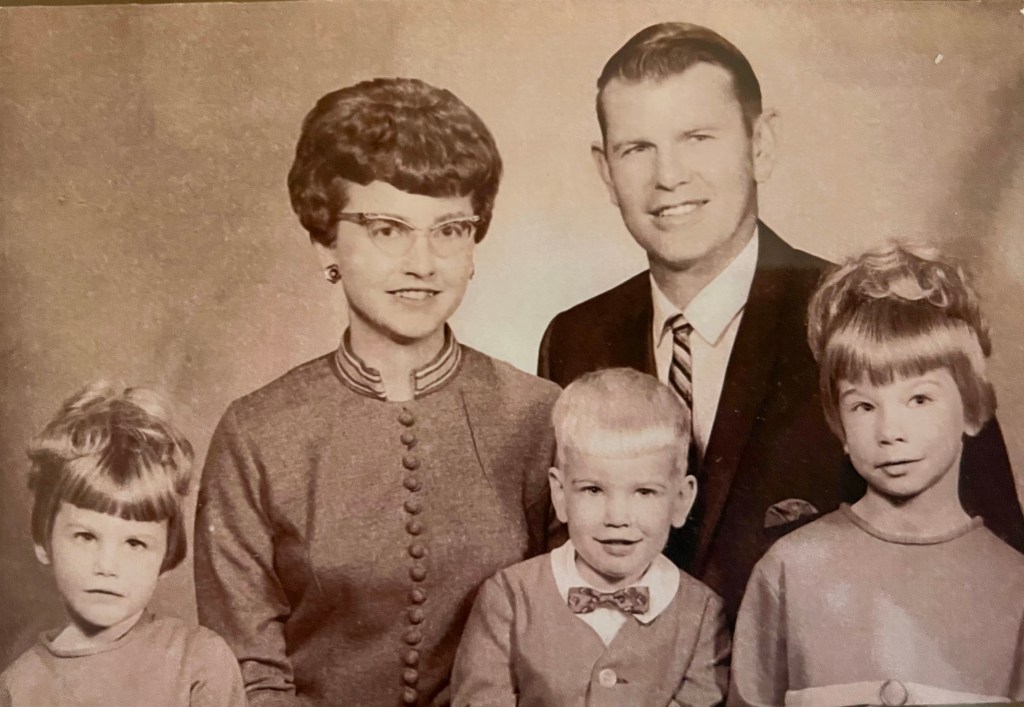
In the early 1970s, my dad served as pastor of First Covenant Church in Cadillac, Michigan. My mom worked as a public health nurse for Wexford County and took classes at the University of Michigan in Ann Arbor to become a Pediatric Nurse Practitioner. If you yapped with my mom for more than ten minutes, you already knew this about her.[1]They say that people tell you the most important thing in their lives in the first ten minutes after meeting them.
In October of 1975, I sat in our family room and looked carefully through the Sears Christmas gift catalog. In some ways, Christmas in the Anderson house was transactional. One would simply pick something out in the catalog, bring it to the attention of our mom and it would appear on Christmas Eve under the tree.
I had never heard of the Guns of Navarone novel, let alone the movie, but upon seeing the cutaway interior of the mountain fortress in the Sears catalog, I was awestruck. I studied the picture in the catalog like a student studies for an important test. Two mounted howitzers, dozens of plastic soldiers and a working elevator to move soldiers up and down the fortress – so many possibilities for hours and hours of death, destruction, and righteous mayhem!
The Nazis were always the bad guys, even though the Korean War and War in Vietnam had been much more recent. One of our favorite outdoor games to play in the neighborhood in the summer was what we simply referred to as “war.” If you were shot during the game, you laid down, closed your eyes and counted to one hundred. After that, you jumped up and went right back into battle. It was like a childhood version of Valhalla.
On Christmas Eve, we ate Swedish meatballs for dinner and headed next door for the evening church service. I wore a white suit with a red shirt and was at the top of the world. Upon returning and gobbling down Swedish Christmas cookies for dessert, it was finally time to open presents. When it was my turn to open my first present, I zeroed in on the Guns of Navarone shaped box, ripped off the wrapping paper, and was thrilled to find that my dreams had been fulfilled.
On Christmas Day, I set up the fortress in my bedroom closet. I staged elaborate battle scenes there for hours, knocking over the plastic soldiers when they were hit by the good guys, or the bad guys.
Later that winter, during an arctic blast, it got so cold that all of the public schools were closed. My dad went to the local hardware store down the street, Gambles, and bought two ski masks. After loading our second-hand skis in the back of our Ford Gran Torino station wagon, we drove to Caberfae, where we skied all morning together. I remember my dad losing one ski somehow at the top of one of the runs. He hobbled down the hill with one ski, cursing as he went after the runaway ski. I smiled and laughed. So did he when he finally caught up with it.
Now that both of my parents have departed, my love for each of them seems to be entering a new phase. Their absence has allowed to soften some of the hard places that always seemed to get in the way when they were here. It is like the war I sometimes waged against them is finally over.
It is Christmas Eve. I’m in my white suit. Dessert is finished. I am waiting to open gifts that they got especially for me. Thanks, mom and dad! I love you.
“When dogs go to Heaven, they don’t need wings because God knows that dogs love running best. He gives them fields. Fields and fields and fields. When a dog first arrives in heaven, he just runs.”[1]“Dog Heaven” by Cynthia Rylant
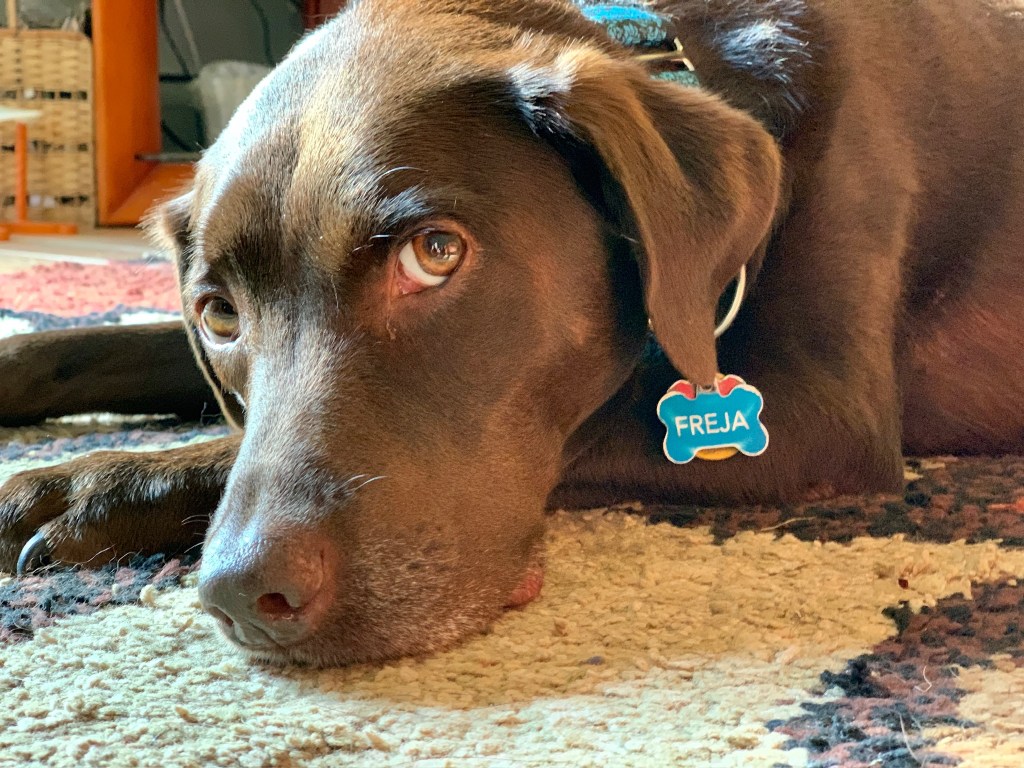
The unthinkable, and inevitable, finally happened. On December 12, 2024, we said goodbye to Freja after fourteen thrilling years with her independent, active soul.
Almost our entire pack was with her when she departed. We gathered around her during her final moments. Jennifer pictured her in her mind’s eye, running after her beloved orange ball into the commons area behind our home. Malin then opened the sliding glass door, and Freja was gone.
As anyone with a beloved furry family member can tell you, losing them is heartbreaking. In the days since she has passed, we have continued some of our daily rituals with her, including walking to her favorite spots in our neighborhood. We love picturing her now running free, her sniffer guiding her wherever she wants to go.
I am convinced that there is a heaven, and that Freja is there, along with my mom and dad, aunt, uncles, grandparents and their grandparents. They will all be there, waiting to greet me there when it is my time to arrive.[2]Who knows when this will happen? I often joke to my friends and family: “Live each day as if it’s your last, and one of these days, you will be right!”
Theoretical physics, and the field of advanced mathematics support the notion that there are many dimensions of reality beyond the four conventional dimensions of space and time. While the actual number of dimensions remains a topic of scientific debate, it does not take much imagination to postulate that time is merely a social construct. “In the worlds above this one, time simply doesn’t behave as it does here. It’s not necessarily one-thing-after-another in those worlds.”[3]Alexander III M.D., Eben. Proof of Heaven: A Neurosurgeon’s Journey into the Afterlife (p. 143). Simon & Schuster. Kindle Edition.
We know only a tiny fraction of all there is to know in our galaxy, much less the entire universe. Acknowledging the limitations of our understanding provides me with hope in what awaits us all somewhere down the line.
A few days after Freja passed, I heard this song by Coldplay, which I often imagine Freja singing back to everyone in her pack:
We’ve been through low Been through sunshine Been through snow All the colors of the weather We’ve been through high Every corner of the sky And still we’re holding on together You got all my love Whether it rains or pours, I’m all yours You’ve got all my love Whether it rains, it remains You’ve got all my love.[4]“All my love” by Coldplay.
I picture Freja eagerly awaiting my arrival, sitting next to her orange ball with great excitement and anticipation about what comes next.
Who knows when this will happen? I often joke to my friends and family: “Live each day as if it’s your last, and one of these days, you will be right!”
“You do not have to be good. You do not have to walk on your knees for a hundred miles through the desert repenting. You only have to let the soft animal of your body love what it loves. Tell me about despair, yours, and I will tell you mine. Meanwhile the world goes on. Meanwhile the sun and the clear pebbles of the rain are moving across the landscapes, over the prairies and the deep trees, the mountains and the rivers. Meanwhile the wild geese, high in the clean blue air, are heading home again. Whoever you are, no matter how lonely, the world offers itself to your imagination, calls to you like the wild geese, harsh and exciting – over and over announcing your place in the family of things.” ― Mary Oliver
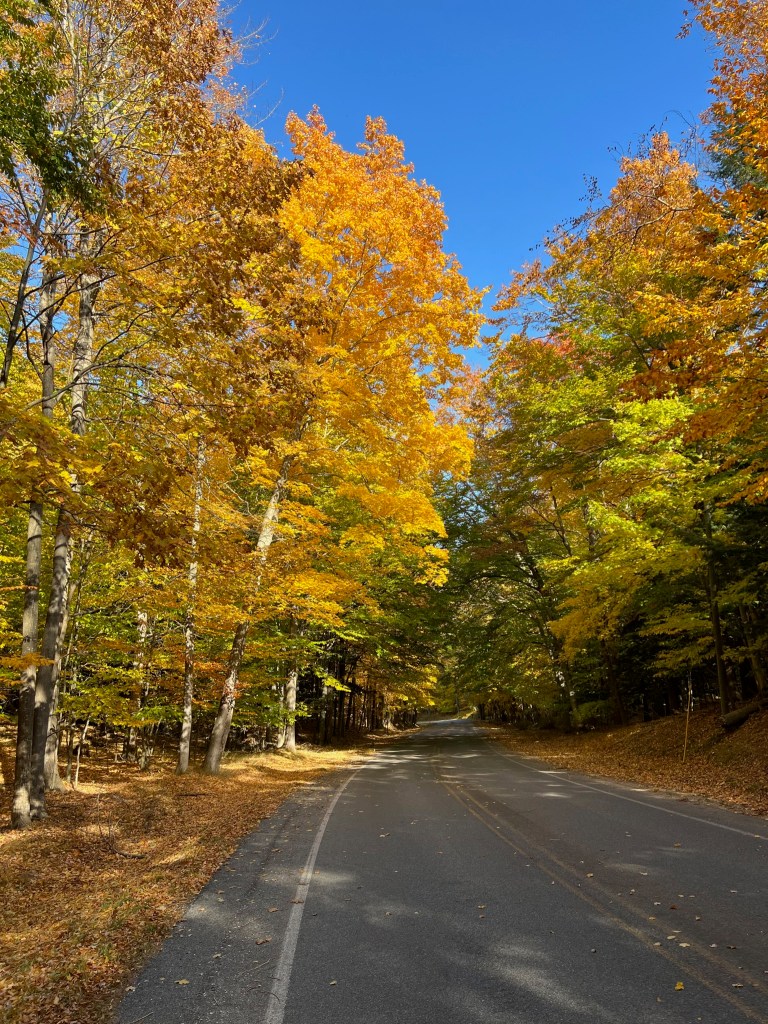
The other day I went to a cider mill with my friend, Anna, after a walk on the West Bloomfield trail. It was a beautiful fall day with a clear, blue sky, and fall colors. I’ve known Anna since my first year at Wayne State University Law School in 1988. We edited articles for the Wayne Law Review.[1]This is where I learned the joy of a good footnote. We eventually worked together at two law firms over the course of our careers. After all of these years, we still have plenty to talk about. This is the best part of friendship. No matter how well you think you know someone, there are always new things to learn.
After the cider mill, I drove home, turning into our neighborhood just behind a school bus. It ambled through our quiet streets, stopping here and there to let off a handful of young children. At each stop, every single child jumped from the bus and ran joyfully into the arms of their moms, dads and other caregivers. I paused, smiled and remembered what it was like with our girls at that age. Where did the time go? Time flies. Don’t miss it.
Jennifer and I both love taking walks with Freja through the park in our neighborhood. We walk slowly these days so that Freja can take it easy, explore every smell, and pursue every possible side track, which makes her happy. After 14 years, she deserves whatever she wants. On our walks, I absolutely love to hear the groups of children playing outside of their apartments next to the park. There is something about kids that is so freeing and joyful. It’s like they are saying: Life is happening now. Joy is here.
Today, I am living life to the full. I am deeply sad. I am also profoundly happy. It’s a paradox. Without lows there are no highs. Indeed, it is pointless to try and run away from the pain. What we resist persists. Negative emotions that we repress grow even more toxic in the shadows. They cause much more harm when they do finally manage to escape.
So I welcome the pain. Bring it! I can handle you – at least for today! I trust that joy is waiting just on the other side.
“The rain to the wind said, You push and I’ll pelt. They so smote the garden bed That the flowers actually knelt, And lay lodged – though not dead. I know how the flowers felt.” ― Robert Frost
“Where there is sorrow, there is holy ground.” – Oscar Wilde.
Erdman Road north of Onekama, Michigan
Lately, I have been cycling on some of the most beautiful country roads in and around Onekama, Michigan. As my riding pal, Jeff, reminds me, “cyclists are not bikers – we cycle.”[1]Jeff is my cycling sensei. He has taught me everything I know about cycling. He also introduced me to The Rules, many of which – except the ridiculous ones – I follow fastidiously.
One spot on my favorite cycling path through the country has captured my imagination: Erdman Road. Along it, I cycle past spacious, working farms, open fields and three hillside cemeteries. Each one is beautiful and quiet. I am in awe every time I cycle down this road. The last cemetery along my route has a sign announcing “Catholic Cemetery” and features a large crucifix at the front.[2]I tell myself that it serves as a reminder so that Jesus knows to stop there first when he returns.
As I cycle on the road past neat rows of tombstones, which are remarkably diverse in size, texture and shape, I always wonder about the gravesites that no one visits anymore. Almost everyone here has certainly been forgotten. It got me thinking: who will remember me when I am gone? Also, what do I actually know about my ancestors?
My great-grandfather on my mother’s side, Carl Johan Engblom, served in the local militia and received good marks for shooting a rifle.[3]Engblom means “meadow flower” and is a soldier’s name. Jennifer’s ancestors in the Swedish military also adopted a soldier’s name: Stadig, or, translated into English, … Continue reading He raised his family on a rocky patch of ground in Småland, Sweden in a small house without indoor plumbing. Carl’s wife, my great-grandmother, died when a horse pulling her carriage got spooked by a backfiring automobile. She was ejected from the carriage and hit her head on a rock.[4]There are plenty of rocks in Småland. Legend has it that when God was creating the world, he was sprinkling rocks over the earth and one of his bags of rocks broke over Småland.
On my father’s side, my great-grandfather, Andrew Gustaf Andersson, emigrated from Lindesberg, Sweden and bought a farm in Swedeburg, Nebraska. He and my great-grandmother, Sophia Skoglund, who came from the same area in Sweden, had eight children. As a child, my grandfather told us that he looked forward to the fall harvest because the corn husks that were used as improvised mattress padding for his bed could be refreshed for the coming year. In addition to raising cows, pigs, and chickens and growing corn, my great-grandfather was a plasterer.
For anyone who has seen me spackle, you know immediately that this skill was not passed down through my DNA.
As for my great-great-grandparents on either side of my family, I do not really have a clue, though I am now in the process of creating a virtual family tree on 23 and Me, where I already have over 1,500 DNA relatives with accounts on the site, which is incredible.[5]https://www.23andme.com.
My father’s mother, June, died tragically during pregnancy.[6]Pain is Necessary. Suffering is Optional. She was laid to rest in Moses Hill Cemetery just outside the remote town of Holdredge, Nebraska. In an example of how small and insular the Swedish-American church community was in the past, Jennifer’s maternal great-grandparents are buried just one row away from June.
As I parse through these scant artifacts, it reminds me that everything we cherish and everyone we love will be lost and forgotten. Other people will live in our houses and, as we approach our final days, our belongings will be sorted by our family members. A few things will be kept. The remainder will be donated or taken out to a dumpster that will inevitably be parked outside of our last earthly home.[7]As they say, you never see a U-haul behind a hearse.
While we are here, each of us can benefit from spending time with our grief instead of running from it. Francis Weller points out that there are two primary sins of Western civilization: amnesia and anesthesia — we forget and we go numb.[8]Weller, Francis. The Wild Edge of Sorrow. North Atlantic Books. There are huge dividends available to us if we slow down and lean into our grief.
In The Wild Edge of Sorrow, Francis Weller wrote about the importance of becoming skilled at working with grief:
Learning we can be with our grief, holding it softly and warmly, is the first task in our apprenticeship. Approaching sorrow, however, requires enormous psychic strength. For us to tolerate the rigors of engaging the images, emotions, memories, and dreams that arise in times of grief, we need to fortify our interior ground. This is done through developing a practice that we sustain over time. Any form will do—writing, drawing, meditation, prayer, dance, or something else—as long as we continue to show up and maintain our effort. A practice offers ballast, something to help us hold steady in difficult times. This deepens our capacity to hold the vulnerable emotions surrounding loss without being overwhelmed by them. Grief work is not passive: it implies an ongoing practice of deepening, attending and listening. It is an act of devotion, rooted in love and compassion.[9]Weller, Francis. The Wild Edge of Sorrow. North Atlantic Books.
Remembering our ancestors, their stories and the people we have lost in our lifetime can help us appreciate the now, including all of its pain and joy. Indeed, “Grief and love are sisters, woven together from the beginning. Their kinship reminds us that there is no love that does not contain loss and no loss that is not a reminder of the love we carry for what we once held close. Alone and together, death and loss affect us all.”[10]Weller, Francis. The Wild Edge of Sorrow. North Atlantic Books.
Cycling down Erdman road, I am surrounded by a great cloud of witnesses. I am not, nor have I ever been, alone.
Jeff is my cycling sensei. He has taught me everything I know about cycling. He also introduced me to The Rules, many of which – except the ridiculous ones – I follow fastidiously.
Engblom means “meadow flower” and is a soldier’s name. Jennifer’s ancestors in the Swedish military also adopted a soldier’s name: Stadig, or, translated into English, Sturdy.
There are plenty of rocks in Småland. Legend has it that when God was creating the world, he was sprinkling rocks over the earth and one of his bags of rocks broke over Småland.
“Out beyond ideas of wrongdoing and rightdoing, there is a field. I’ll meet you there. When the soul lies down in that grass, the world is too full to talk about.” – Rumi
My mom could deliver judgments from the bench at a rate that would put Judge Judy to shame.[1]See https://en.wikipedia.org/wiki/Judge_Judy. It is obvious that I have unresolved “issues” with my mom, as she somehow keeps finding her way into these posts. So I continue to post these … Continue reading
No one within reach of Ingrid was spared. Her critiques were usually witty, brutal and accurate. You would think that the pastor’s car on the way home from church would be a place filled with engaging and profound discussions about heavenly matters. Instead, Ingrid went down the list of the faithful as we drove home, dolling out imaginary awards for crimes against humanity committed by members of our little flock.
Of course, she had plenty of good things to say about folks, too, as long as they didn’t cross her. We knew many delightful people and they were duly praised and complimented. My mom called this “giving people strokes.”[2]But not that kind of stroke. According to research, “the ideal praise-to-criticism ratio is 5:1. Meaning, for every negative comment you make, you need to share five positive comments as well.”[3]https://hbr.org/2013/03/the-ideal-praise-to-criticism
I was taught by my mom to view people in black and white terms, which is, of course, wrong. Everyone is shades of gray, even on our best days. My mom confronted our friend, Norma, during a discussion with a nurse about my mom’s medication (a favorite topic): “Norma, are you for me, or against me?” When Jennifer joined our family, and started attending church with us, she marveled at how brutal we could be, even though our comments were often masked by humor. Of course, our family’s criticisms sprang from a deep well of insecurity and shame.
Since my experience growing up is what comes naturally to me, if I am not mindful, I can easily return to the backseat of our old family sedan in 1982, taking pot shots at those around me with the best of them.
Today, when these temptations to judge grab hold, if I happen to be in a mindful state, I counter them with the lovingkindness prayer:
I can’t tell you where I learned to use these particular words, but they are easy to remember, which makes them handy.
First, I picture someone who is easy to love, like our nearly 14-year old chocolate lab, Freja. May you be well. May you be happy. May you be free from suffering.
Next, I picture someone with whom I have a neutral relationship – a person who I have no strong feelings about, either positive or negative. May you be well. May you be happy. May you be free from suffering.
Finally, I picture someone who is difficult for me – for example, someone with whom I have a complicated relationship, or someone who has hurt me. May you be well. May you be happy. May you be free from suffering.
The lovingkindness prayer helps me to settle my busy and anxious mind. A good time for me to say this prayer is when I have my morning or afternoon coffee, if I am able to savor the moment without simultaneously gazing into the screen of a laptop, iPhone, iPad or Kindle.[5]There are so many devices now. What was life even like before we had these beautiful screens available 24/7? What did introverts do with the inability to escape easily into the wonders of the web? … Continue reading
Practicing lovingkindness is a remarkably effective way of slowing down and putting everything into perspective. There I hope to find a place where words escape me, and love overtakes me.
You have traveled too fast over false ground; Now your soul has come, to take you back. Take refuge in your senses, open up To all the small miracles you rushed through. Become inclined to watch the way of rain When it falls slow and free. Imitate the habit of twilight, Taking time to open the well of color That fostered the brightness of day. Draw alongside the silence of stone Until its calmness can claim you. Be excessively gentle with yourself. – John O’Donohue [6]John O’Donohue, excerpt from the blessing, For One Who is Exhausted, “To Bless the Space Between Us.”
See https://en.wikipedia.org/wiki/Judge_Judy. It is obvious that I have unresolved “issues” with my mom, as she somehow keeps finding her way into these posts. So I continue to post these thoughts in an arguably vain attempt to continue the healing process for these wounds. I also hope these writings find some kindred spirits out there. James Joyce said, “in the particular is contained the universal.”
There are so many devices now. What was life even like before we had these beautiful screens available 24/7? What did introverts do with the inability to escape easily into the wonders of the web? Where did we go? Did we just stand there on the edge of the group, smiling awkwardly? Sounds about right.
The parsonage next to the Covenant church in Gladstone, Michigan
I was born in the sixties in the town of Gladstone, Michigan. Gladstone is located in Michigan’s vast upper peninsula, about an hour and a half away by car from Spread Eagle, Wisconsin. I have only a few memories from Gladstone.[1]In 1971 my dad accepted a call to pastor a church in Cromwell, Connecticut.
By the time I arrived, my parents had embraced fully the free-range style of parenting championed by the widely popular Dr. Benjamin Spock.
“Hoping to enhance psychoanalysis in the pediatric world, Benjamin Spock authored a book called The Common Sense Book of Baby and Child Care. The book, which was released in 1946 and soon became a best seller, encouraged free-range parenting with the hopes of implementing Freudian philosophy into child-rearing.”[2]https://en.wikipedia.org/wiki/Free-range_parenting.
My parents were not alone in jumping on the Dr. Spock bandwagon. Indeed, Gen X is commonly referred to as the latch-key generation. “As children in the 1970s and 1980s, a time of shifting societal values, Gen Xers were sometimes called the “latchkey generation”, which stems from their returning as children from school to an empty home and needing to use a key to let themselves in.”[3]https://en.wikipedia.org/wiki/Generation_X
Loren and Ingrid embraced free-range parenting and took it to new heights. For example, a stranger found my sister Susie, at the tender age of five years, wandering alone in the afternoon on our busy street and brought her to the parsonage to a very surprised Ingrid.
I have a scar still visible on the top of my left hand from a third degree burn. I earned this scar ironing clothes completely on my own. I had seen my mom do this before and I just wanted to help. The ironing board was too high for a toddler to reach, but I quickly solved that problem by scooting over a chair. I’m not sure what my mom told the emergency room doctor about what she was doing at the time of the accident, but she wasn’t there.
Susie, Ingrid, Tim, Loren and Sheri
I picture me as a small child trying to figure out what the heck was going on with parents who were publicly organized and responsible, but privately distracted and careless. I’ve said it before: I knew that my parents loved me. I also knew at an early age that I was very much on my own.
This describes the situation really well:
[W]e become confused and suspicious. We stop trusting and begin to count only on ourselves. We do this out of a need to protect ourselves from the emotional pain that results from our parents’ inconsistency. What we come to know is that the only thing for sure is that nothing is for sure . . . . When our parents tell us lies and make promises to us they can’t or won’t keep, we begin to question our own worth. The child wonders, “Do they treat me that way because they don’t love me?” If a child lacks trust in his parents’ love, then it’s not difficult to imagine how he might begin to feel insecure within himself and end up developing a real fear of abandonment in all his relationships.[4]Subby, Robert C.. Lost In The Shuffle: The Co-Dependent Reality (pp. 41-42). Health Communications Inc. Kindle Edition.
The result for me, growing up in a hands-off environment, was persistent insecurity, anxiety and extreme people pleasing behavior hard wired deep into my soul.
Unable to count on our parents’ approval, and fearful of abandonment, we sought out new and indirect ways of getting our needs met. Conscious or otherwise, we began to manipulate others to give us validation and love. Believing that who we are inside is not good enough or deserving enough, we hide our unacceptable selves. We learn to do those things which we think will bring us approval from others. Once in place the private logic of “I am not okay” becomes the self-defeating foundation of our shame.[5]Subby, Robert C.. Lost In The Shuffle: The Co-Dependent Reality (p. 42). Health Communications Inc. Kindle Edition.
Fast forward to our family. When our girls were young, on Saturday morning we would play with their Playmobil sets. Sifting through the pile of plastic pieces strewn across the family room floor, I would attach a lamp from the Playmobil barn to the horn of a Playmobil cow, making a bovine laser. Pew pew pew! We would all laugh together and be silly. Like all dads, I missed the mark sometimes. But on Saturday morning our girls knew that we were together, things were ok, and that I loved them.
Comments from Tim’s cousin, Kurt Elia, in response to this post:
“Another good post, Tim. It really is something to look back on how we were parented through the eyes of who we are today, and give thought to how we have parented our own kids. It’s a witch’s brew of so many things: hands-on vs hands-off philosophy, what society is telling us at that moment, the personalities of each individual kid, and the psychological issues that the parents are going through. No single thing on its own can explain the ultimate result, but it is really helpful to go back and try to understand each element.
I look back on my own parenting and can think of plenty of things I wish I had done differently. Ironically, I often wish that I had been *less* hands-on with the kids, as there is a certain self-reliance and confidence that is born of giving kids the space to solve their own problems. I think that one of the reasons for the anxiety epidemic that teenagers today are experiencing is that parents in our generation tried to protect them too much from the world, and so they never developed their own sea legs.
I guess the most important thing is love, and how that love is born out through real conversations with kids, and consistency in word and deed. Another key element is making real apologies to our kids when we (inevitably) screw up from time to time. It is amazing what people will forgive if you give them the chance, and more importantly, if they know that you know that what you did was wrong, they know that you respect them and they are less likely to develop the kind of dysfunctional view that they are somehow to blame and need to work harder to please us.
It’s funny, the more I think about parenting, the more it seems like many of the same lessons for being a good leader apply to being a good parent.
Parent: Make sure you kids know you love them unconditionally
Leader: Make sure your team knows you have their back
Parent: Teach and coach your kids to help them learn from their mistakes. Don’t do everything for them. Balance support with challenge.
Leader: Teach and coach your team to help them learn from their mistakes. Don’t micromanage.
Parent: Set clear rules for what constitutes acceptable behavior, and consistently call people out (including yourself) when they violate those rules. Do this in a way that explains why violating these rules is bad for the kids individually and for the family as a whole.
Leader: Ditto
Parent: Expect your kids to do their best, but don’t punish them for failing to achieve the desired result. Focus on what motivates your kids (the “why”) and the things they are doing to try to achieve it (the “how”), not how good or bad the outcome is right now (the “what”).
Leader: Teach and reward good consistent process, and let the results take care of themselves.
Parent: Remember your kids are always watching you and will emulate your behavior for better or worse.
Leader: Lead by example.
Parent: Remember you have more power and experience than your kids. Be patient with them. Don’t be petulant. Take the hits they can’t. Be the bigger person. Seek to understand. Be slow to anger.
Leader: Give your team all the credit, and take all the blame yourself.
I could go on, but you get the point. Too bad we only learn this stuff after our days of leading and parenting are mostly behind us!”
The Spread Eagle chain of lakes in Wisconsin – just across the border from Iron Mountain, Michigan.
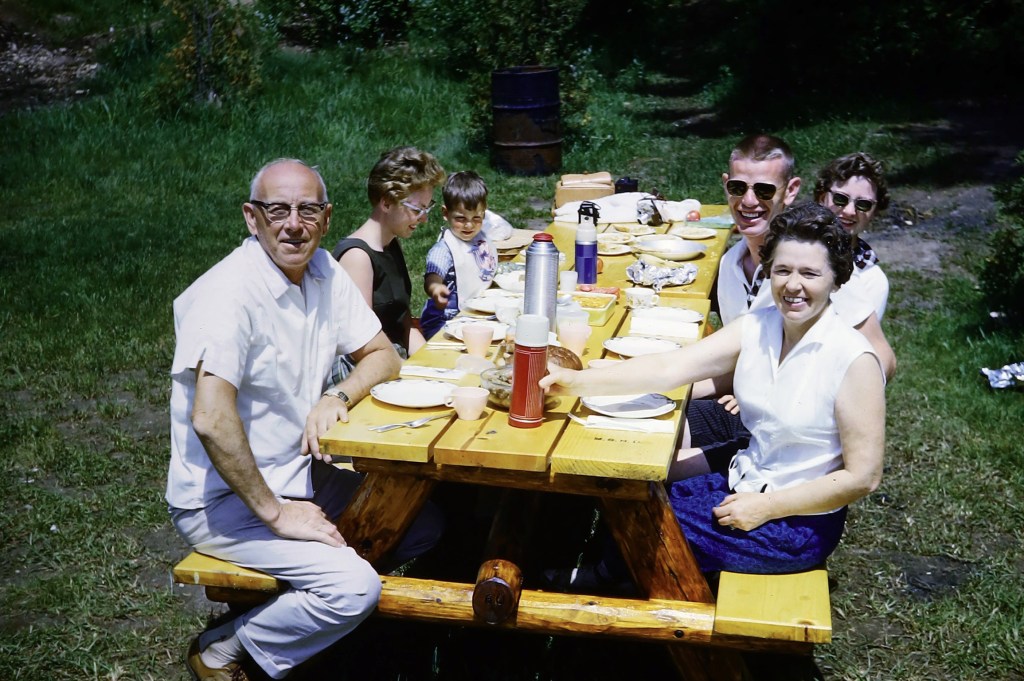
My cousin, Kevin, recently digitized family slides and shared them with the family. Going through the collection, I kept coming back to pictures of my Swedish grandparents’ summer home in Spread Eagle, Wisconsin. It remains a veritable Shangri-La in our shared family history. The memories I have from time I spent in Spread Eagle, are sparse, but they are also quite vivid and magical.
My mom’s parents, Gunnar and Ruth Engblom, bought Spread Eagle in 1958. Gunnar sold the place in 1974 after Ruth died. I remember floating in an inner tube next to the dock on Spread Eagle as a boy, thinking: “This is it. This will be the last time I swim here – ever.” When Spread Eagle was sold, a beautiful chapter closed in life for all of us.
I’m not surprised that Gunnar and Ruth fell in love with Spread Eagle. The lake is very similar to the lakes around Grimslöv, Småland, the area in Sweden they left in the 1920s. They were among the 1.3 million Swedes that traveled across the ocean, looking for a better life in America. They were happy here. After arriving in Chicago via Ellis Island, Gunnar reportedly refused to speak Swedish out of respect for his new country.
Gunnar, Evie, Kevin (on left). Ruth, Loren and Ingrid (on right), enjoying “fika” in Wisconsin. My dear Uncle George took the picture.
I learned as a small child the wonders of life on a quiet lake, the smell of gasoline in the yellow boathouse, the thrill of riding in my grandfather’s speed boat or being pushed in a wheelbarrow down the driveway by him. I learned about coffee, which my grandmother served to me in a tiny cup with lots of cream and sugar, as any good Swedish grandmother would do.
I also learned how to savor every moment, knowing that things in life do not last long, which makes life precious. It all goes by very fast. We are here one day, and gone the next.
“Nature’s first green is gold, Her hardest hue to hold. Her early leaf’s a flower; But only so an hour. Then leaf subsides to leaf. So Eden sank to grief, So dawn goes down to day. Nothing gold can stay.” – Robert Frost
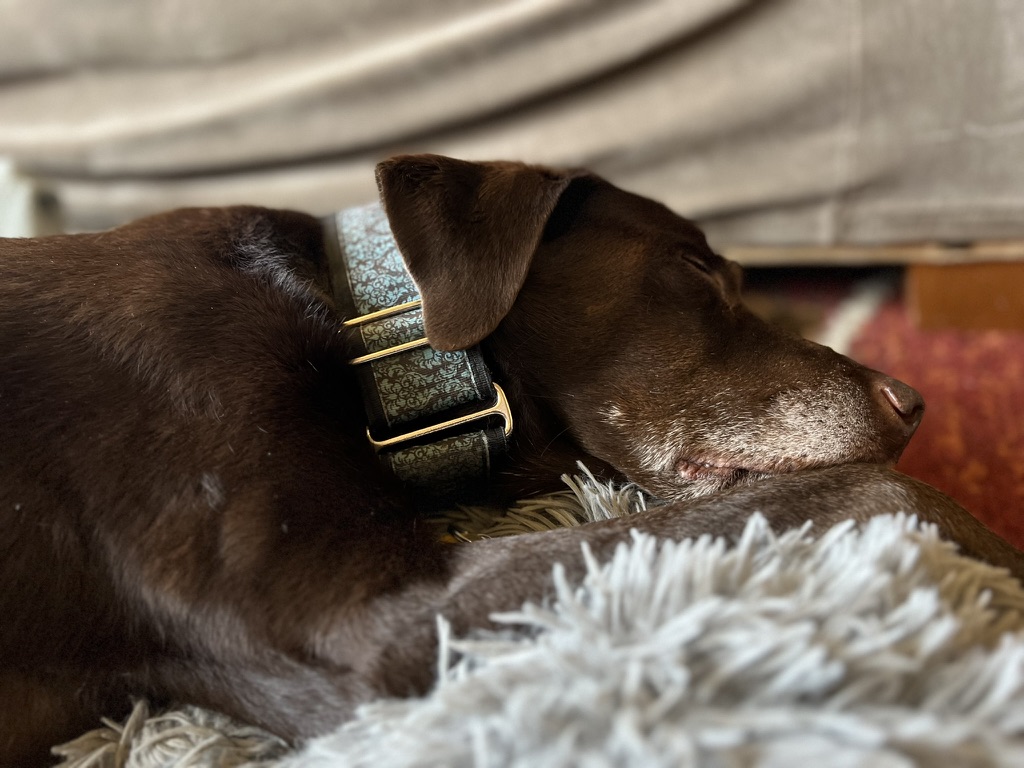
Freja sleeps and dreams of fetching balls and being chased by other dogs as a young pup
“What lies behind us and what lies before us is nothing compared to what lies within us.” – Ralph Waldo Emerson
My days now are quiet, which is how Freja and I like ’em. Jennifer is a different story. Her energy is boundless and her network of friends and colleagues seems to grow bigger every day.[1]Was I like that before? I guess I was, and yet this seems so foreign to me now. Like a different version of me altogether – not better or worse, just a highly caffeinated version of me. I still … Continue reading Despite the quiet around me, my brain still keeps chattering away, like bees buzzing in and around their hive. I do my utmost to keep negative thoughts at bay, but this is easier said than done. The algorithms on social media have my number dialed in. I noticed the other day that the Instagram app on my phone now lacks a pause button, making it even more difficult to get away from scrolling. It just keeps going and going and going from reel to reel until I am able to stop after a while, look around and ask myself, “what in the heck are you doing?”
So much of the world now is dark and violent. I guess it should not surprise anyone that the channels we tune into now on our TVs for relaxation are also dark and violent.[2]What did they say about art imitating life? It takes diligent, focused effort to find media of any kind with positive vibes. More often than not I am only able find positive material in the analog world of books and journaling by hand. Even then, my negativity bias wins out if I am not paying attention. The other day, I needed to put down The Stand by Stephen King and pick up The Good Neighbor: The Life and Work of Fred Rogers by Maxwell King. Fred Rogers was an amazing human, and reading this book is both calming and inspiring. Stephen King can wait.
In peaceful moments, I can only marvel at the millions of details and relationships that needed to align throughout my nearly 60 years of life, enabling me to arrive here in this moment, more or less intact. As a teenager, I almost flipped over a heavy tractor onto myself while mowing grass on a hill. I nearly mangled my legs in the water behind a moving outboard boat motor. I also nearly shot myself with a live round of .22 caliber ammunition,[3]https://realifematters.com/2020/09/06/locked-and-loaded-ptsd/ not to mention almost breaking my legs attempting to zip line down a telephone pole wire. Call it dumb luck or providence, I am still here, alive and mostly well. In the words of Michel de Montaigne: “My life has been full of terrible misfortunes, most of which never happened.”
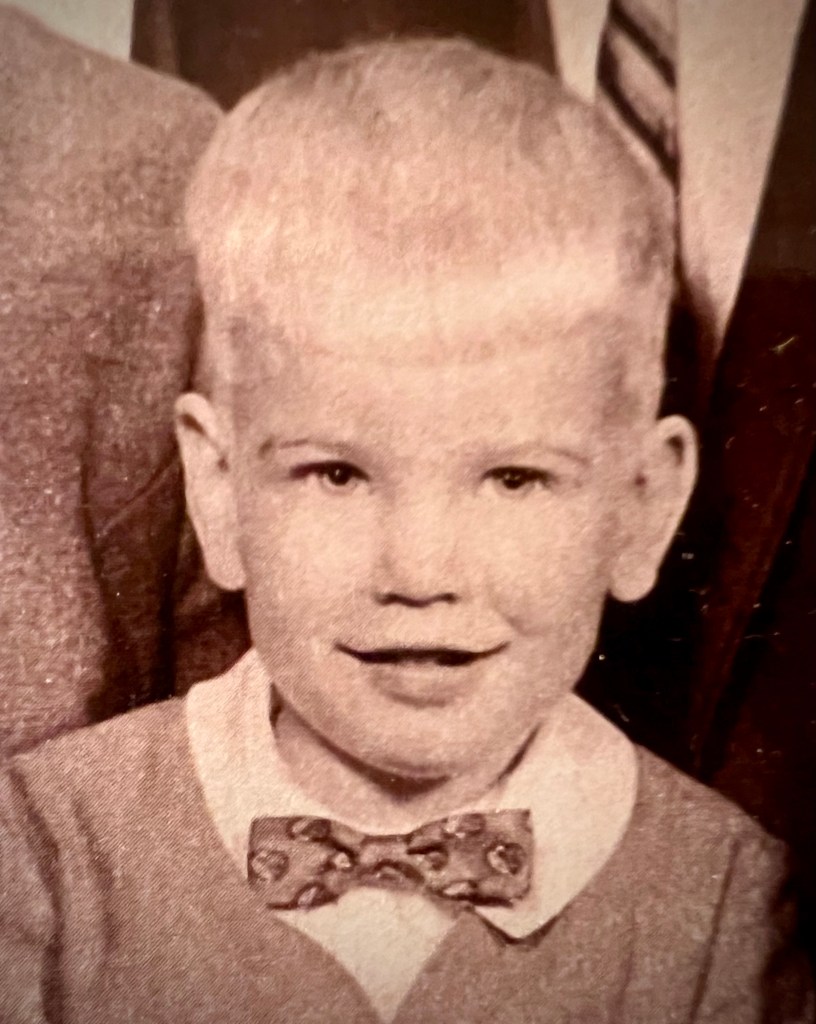
When I was a young boy, I’m told that someone asked me what I wanted to be when I grew up. I told them that I either wanted to be a minister or a dog. If I was a minister I would go to work with my dad, and if I was a dog I would bury bones in the yard with our dachshund, Andy.
I just walked down to the front room where Freja was sleeping in the morning sun. I told her about my boyhood dreams. I scratched the inside of her ears. She gave me a big stretch, and sighed. Dogs know about living life to the full, and I am joining her fully in this moment.
“We must be willing to let go of the life we planned so as to have the life that is waiting for us.” – Joseph Campbell
Was I like that before? I guess I was, and yet this seems so foreign to me now. Like a different version of me altogether – not better or worse, just a highly caffeinated version of me. I still love coffee, but these days I can only handle half-caff in my mug.
“The deeper the sorrow, the greater the joy.” – William Blake
One of the most adorable things that Malin did as a toddler happened at Christmas. Visiting grandma and grandpa in Nebraska, she removed the tiny wooden Jesus figure from grandma’s nativity scene, rocking it ever so gently in her arms and looking up to Jennifer, saying, “Mamma… Baby Jesus cry.” With her lisp, the “r” sound in the word “cry” was absent, making her observations even more adorable.
Almost all children, especially young children, are able to cry freely. Indeed, healthy infants are born into the world crying. Research also shows that children laugh about 400 times a day, but adults on average laugh only about 15 times.[1]https://www.ncbi.nlm.nih.gov/pmc/articles/PMC6609137/
Raised in the 1970s in the Midwest as an American male, I learned early in life that it was not acceptable for me to show any kind of weakness – especially, to cry in public. Instead, I was taught to keep a stiff upper lip and let whatever was bothering me to roll off my back, like water off a duck. At least, this was the idea.[2]In reality, of course, emotions that are denied are unable to be processed and accumulate in our system until they express themselves in other, less healthy ways. Like all of my friends and their brothers and fathers and uncles, I learned to practice the subtle art of denial when it came to dealing with any sad emotions. Picture Tom Hanks in A League of their Own: “Are you crying? There is no crying in baseball!“
In the winter of 1975 my sister Susie fell on my arm while we were playing on a huge snow pile in the church parking lot. When I started to cry, she scolded me: “Don’t be such a cry baby!” I finally relented and went inside, where nurse Ingrid appeared and knew instantly that my wrist had been fractured. The emergency room physician who fixed my wrist was impressed that I was able to be brave and not cry. He said, “Mrs. Anderson, you have a superb boy.”
The consequences of denying the expression of emotions, including sadness, on our emotional life are profound:
“When we send our grief into exile, we simultaneously condemn our lives to an absence of joy. This gray-sky existence is intolerable to the soul. It shouts at us daily to do something about it, but in the absence of meaningful ways to respond to sorrow or from the sheer terror of entering the terrain of grief naked, we turn instead to distraction, addiction, or anesthesia.
On my visit to Africa, I remarked to one woman that she had a lot of joy. Her response stunned me: “That’s because I cry a lot.” This was a very un-American sentiment. She didn’t say it was because she shopped a lot, worked a lot, or kept herself busy. Here was . . . sorrow and joy, grief and gratitude, side by side. It is indeed the mark of the mature adult to be able to carry these two truths simultaneously. Life is hard, filled with loss and suffering. Life is glorious, stunning, and incomparable. To deny either truth is to live in some fantasy of the ideal or to be crushed by the weight of pain. Instead, both are true, and it requires a familiarity with both sorrow and joy to fully encompass the full range of being human.[3]Weller, Francis. The Wild Edge of Sorrow (pp. 110-112). North Atlantic Books. Kindle Edition.
I can’t remember the last time I cried, either sad or happy tears. But I am committed to allowing the limits of my usual emotions to expand, including re-learning how to cry. A life filled with more tears will make me a more complete human being.
“When death finds you, may it find you alive.” – African Proverb
In reality, of course, emotions that are denied are unable to be processed and accumulate in our system until they express themselves in other, less healthy ways.